Search This Blog

Saturday, November 21, 2020

Early Oxford Colleges

Yes, you're right - these aren't Augustinian seals, so this is a tangent.
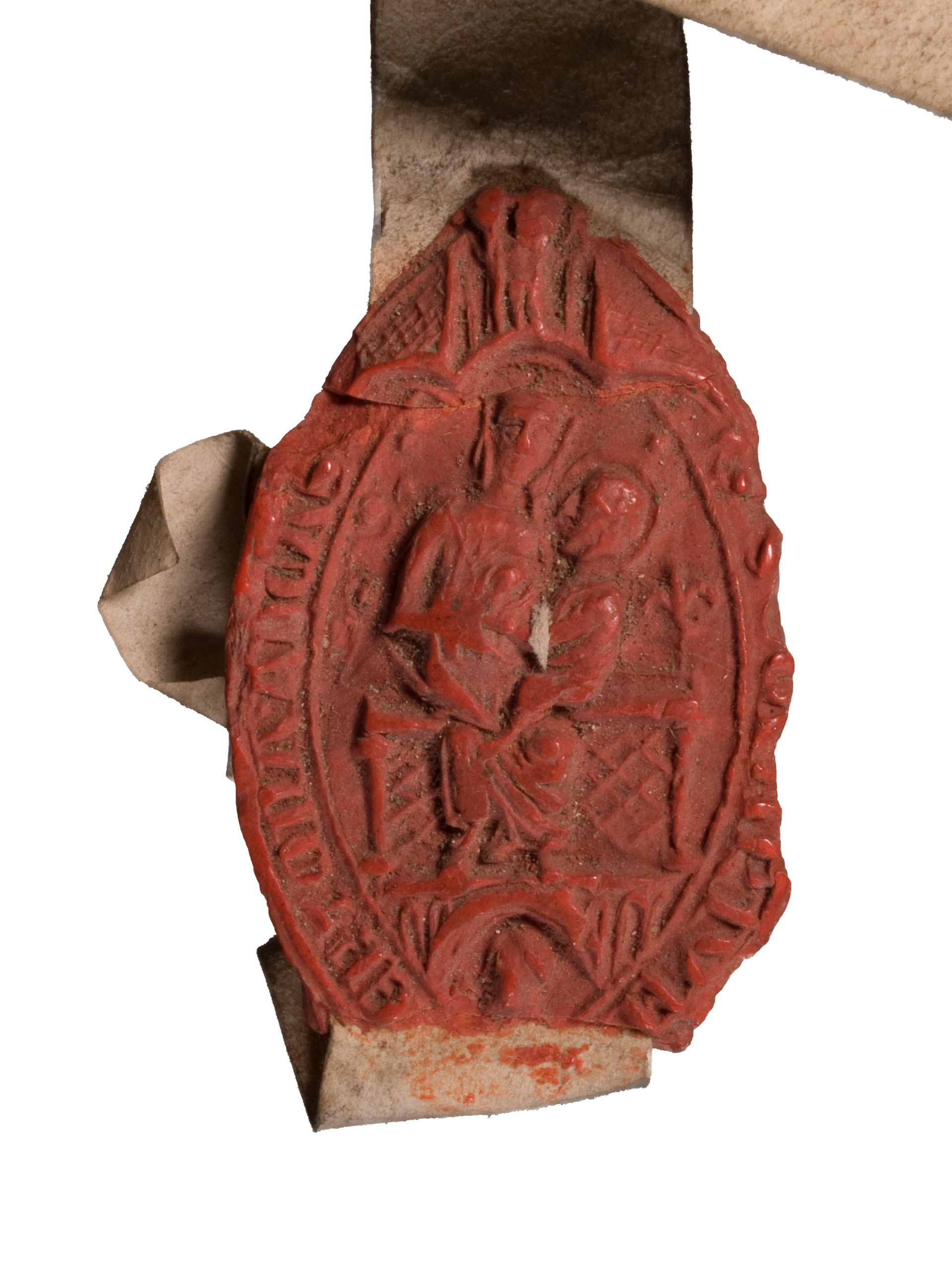
I'm just looking at the histories of Merton, Univ and Balliol Colleges, all founded in the 1260s.  

The Merton seal (from their archives) is from the 14th century. It is the BVM and Babe, she with orb, and with the half-figure of Walter de Merton praying under an arch below. I'd like to draw your attention to the seals of Oseney Abbey and Merton Priory - Walter had associations with both (especially with Merton, whom he named himself after).  Both monasteries were, like so many Austin houses, dedicated to the BVM. Merton's chapel is dedicated jointly to the BVM and St John the Baptist.  Walter's own seal has similarities to Merton's, too.

A quick look on the internet has failed to provide Univ's seal, but here's Balliol's, from 1282.  Although John de Balliol is credited with founding the college, it was actually his wife Dervorguilla of Galloway.
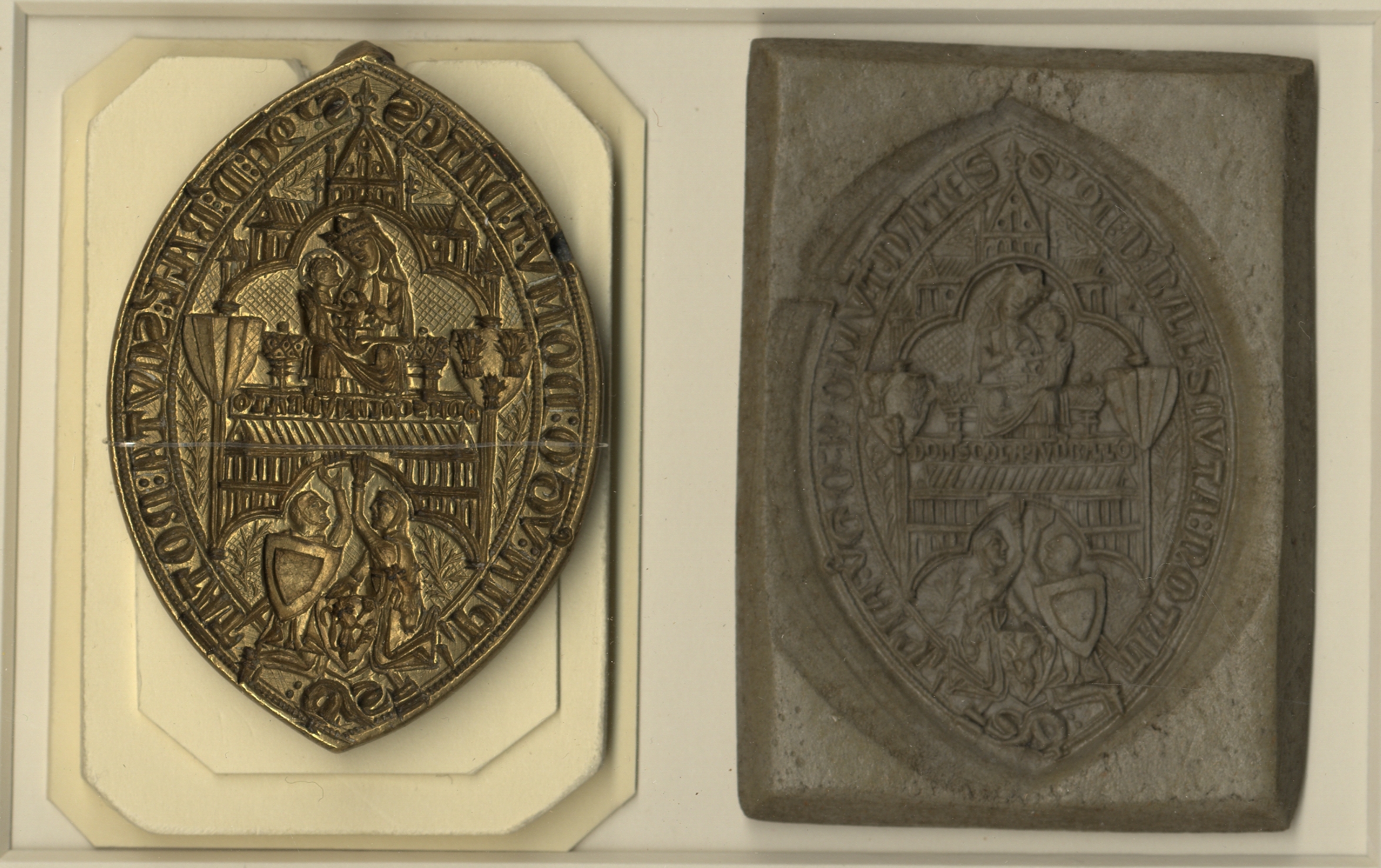
This seal has again the BVM and Babe and is very like Oseney's or, with its canopy, Merton Priory's. But in addition, they BVM and Babe are sitting atop a building (the scholars' hall?), with John and Dervorguilla praying underneath.  Unlike Merton College's seal, this one is very heraldic, showing the secular, noble origin of the founders. John holds his shield (Gules, an orle Argent. By the BVM and Babe are, sinister, the arms of her mother Margaret of Huntingdon (Or, three piles Gules.  Margaret was great-granddaughter of David I, brother of Edith-Matilda - both of whom were responsible for several early Augustinian foundations. The other arms (per pale Gules and Azure, three garbs Or) are the de Lacy arms. Alan of Galloway married first and thirdly de Lacy women. (It's interesting she displays de Lacy rather than Galloway/ Scotland.)  Dervorguilla's own seal is here, for comparison.

Wednesday, November 18, 2020

Huntingdon

 This post lacks a picture, owing to the difficulty of getting into the BL, and there being no picture anywhere on the internet.  So for the moment, we'll just have to have de Gray's description.

This post also led to me editing the Wikipedia article on Huntingdon Priory.  Hopefully more people will add to it, amend it, etc.  Huntingdon was one of the original Augustinian priories, and is, like so many, dedicated to the BVM.

Its surviving seal is from the 14th century:

"the Coronation of the Virgin, in a circular panel, cusped and quatrefoiled. Over it the head of Our Lord with cruciform nimbus, between a crescent on the left and an estoile on the right over which are the sacred letters AO. At each side a four-winged seraph. In base, The Resurrection of the Dead at the Day of Judgment, two angels blowing long trumpets, three human figures rising from the ground, and a bishop or mitred Abbat rising from a sepulchre.

: * : S' : COMMVNE : RVM : . . MARIE : HVNTINGDONE.

R. The Priory Church, with central spire and crested roof. In the middle, under a trefoiled arch, St. Augustine, Archbishop of Canterbury, seated, lifting up the right hand in benediction, in the left hand a crozier. At each side in a niche with trefoiled arch two canons praying. Over each niche in a circular panel window the head, on the left of St. Peter, on the right of St. Paul. In the field, on the left the keys of St. Peter, on the right the sword of St. Paul, each betw. two roses. In base, under an arcade, four busts in profile to the left Over the roof the words CLEM. V., in reference to Pope Clement V., A.D. 1305-1315."

The legend is a rhyming hexameter couplet: CANONICIS : LEGES : P’R : AVGVS / DE : H' PIA DONA TVIS.

I'll improve this post when I have a photo or two.

Monday, November 16, 2020

Holyrood

 Holyrood Abbey was founded in 1128 by David I of Scotland, brother of Edith-Matilda, one of the key figures in the establishment of the Augustinians in the British Isles.  David's founding canons were from Merton Priory, but unlike Merton and many other Austin houses, Holyrood is not dedicated to the BVM, but to, er, the Holy Rood (St Cross).  This could have been because David, about to be gored by a stag who'd already managed to unhorse him, saw the holy cross and was miraculously saved, or (/ and) because David brought there a fragment of the True Cross from Waltham, which had been given it by David's mother Margaret (the Queen of Queensferry and founder of Dunfermline Abbey).  After being a centre of spiritual and political importance for the next few centuries, Holyrood was trashed by the English in the 1540s and then by the Scottish reformers of the 1550s.  In 2006, Time Team dug up various bits of it.

The first seal of Holyrood is a church (compare St Andrews, for example).  It's lovely.  Look at the tiles; the dome is beautifully Romanesque, and the arcade also classic Romanesque.  The ground below it is interesting - a forecourt?  De Gray Birch gives this a date of c.1141.  The legend is SIGILLVM S[ANC[TE] [I can't make the next bit out] EDINBURGENSIS ECCLE[SI]E

©National Museums Scotland
From a century or so later is Abbot Adam's seal.  This shows Adam kneeling in prayer, with his crozier, to the Holy Rood, and there are crosses aplenty.  Legend:  S' ABBATIS SANCTE CRVCIS DE EDINGBORG.


The final seal, at least on this page, is the Abbey's seal from much later - de Gray Birch's example from 1559.  It's definitely Late Mediaeval, though could be 15th- or 16th-century.  It is busy, with Christ crucified in the middle (St Cross, again) and the BVM and John (I presume) either side - these two centuries loved the Passion story, as you can hear from the numerous Eton Choirbook examples (like this one).   Beneath is the BVM and Babe, and the arms of Scotland.  Lovely elegant Perp columns and canopies.  (Again, I can't quite make out the legend from this picture.)


Thursday, November 5, 2020

Southwark's First Seal

The Priory of St Mary Overy, or Southwark Priory, was founded in 1106 by Williams Pont de l'Arche and Dauncey.  They were two curiales in the court of Henry I. Henry had quite a lot of curiales. The word means courtier; these were the royal men-of-business. Typically, they came from lesser families and owed their good positions and fortunes to the king - and queen. These two Bills were indeed Henry's men, but they also acted for his wife, Edith-Matilda, whose importance can be overlooked because she was queen-consort, but it must be remembered that she was of royal descent and could argue a position of queen in her own right. Edith-Matilda was fundamental to the establishment of the Augustinian order in England, Wales and (through her brothers) Scotland.

Walter de Gray Birch puts the first seal in the 11th century, but it can't predate the priory, so it must be first quarter of the 12th. Here's his description of Southwark Priory's seal:

Pointed oval: a king, standing, with crown having loose straps terminating in trefoils, as in the great seal of William II; with long open sleeves, in the hands an inscribed ribbon. The inscription is illegible.

+ SIGILLUM SCE MARIE SVDWERKENSIS ECCL'IE

Why it should be a king when the priory was dedicated to Mary, I'm not sure. Kings are also usually depicted seated on a throne. William Rufus' crown type might be similar (it's of the right period), but otherwise, he's, ahem, a red herring. Here are the seals of the Norman kings:

Kings, as you can see, don't stand. But queens do. If we compare the Southwark seal to that of Edith-Matilda, we see certain similarities (and some differences).

Here she is. (There's another, better, picture on the Durham seals site.)

I don't know on what grounds WdeGB thought Southwark's figure was a king, but a wide-sleeved standing figure is surely more likely to be female. From this photo, it looks like the figure has a beard, but that might be a bad impression. One day, I'll go and have a look at the seal itself.

I've not come across another seal (yet) with the ribbon or banner. The pattern on the vestment is interesting - and a bit unclear. Perhaps it's the Lamb of God? Some things seem to be projecting from behind the figure's head. A possibility is that this figure isn't royal, but episcopal. Bishops also stood and had wide sleeves. The bishop of Winchester was closely connected to Southwark (indeed, the prostitutes of Southwark were called the Winchester Geese).

Two possible models for this seal exist: Edith-Matilda, patron of the two curalis-founders, and William Giffard, bishop of Winchester (or St Augustine, via him). This seal needs more investigation!

The second seal, also from the 12th century, is the BVM seated, and once I've located a picture of it, it'll be here.

Wednesday, August 5, 2020

Nostell

Almost as much remains of Nostell as it does of Merton; Merton is covered by a big supermarket, and Nostell by a big Georgian stately home - both signalling the change from religion to consumerism.  Nostell was, like Merton, one of the big founding priories, sending canons all over the place to establish other Austin houses. Nostell grew from a hermitage in St Oswald's Wood, near Pontefract, becoming an Austin house by 1120.  It was patronised by the de Lacy lords of Pontefract, and then Henry I; his archbishop of York, Thurstan, was quite possibly responsible for turning it into an Austin priory.  (The Borthwick Institute says J. A. Frost's useful booklet on Nostell is out of print; you can find the first 9 pages here.)  Nostell soon grew to be one of the top three northern Austin priories.

Left is the priory seal from the early 12th century.  It shows St Oswald, with a crown which looks unfortunately like a jester's hat.  He is seated on a throne with nice wolf-head ends, and he holds an orb and sceptre.  The legend:  SIGILLVM [SCI] OSWALD' REGIS & M DE NOSTELT

Oswald was a 7th-century king of Northumbria who promoted Christianity. He gave Aidan, the 'Apostle of Northumbria', Lindisfarne as the centre of his bishopric.  Oswald he was killed in battle with the Mercians, and his body cut into pieces and put on spikes.  Miracles of course occurred where he died.  Oswald's head was buried in Durham Cathedral (although several rival heads exist elsewhere), and one of his arms turned up at Peterborough, where monks would guard it continuously to stop relic-theft.  In the feretory at Durham, you can see a late-medieval statue of St Cuthbert holding St Oswald's head.

The counterseal, from later in the century, shows the BVM and Child on her lap. She holds, as Charles Clay said, 'an object in either hand'.  It's difficult to make out those objects, but the right-hand one will be a sceptre, because it usually is.  The legend is +  CONTRASIGILL' SANCTI OSWALDI DE NOSTLE:

A further, 13th-century, seal exists (in the National Archives), possibly the privy seal or ad causas; I don't have a picture, but Clay's description is: Round, 1 in. The Virgin and Child, half-length, between four large pointed leaves. * MARIA MA…….ENA.
Prior Robert de Quixley (1393-1427), who had the history of the Priory compiled (the legend of the Priory, anyway), had a nice seal (left).  It has two tiers. In the upper, St Oswald, seated on a throne, holds a sceptre between two clergy with croziers. Below, Robert himself, vested for mass, stands between two canons. The legend has a couplet feel about it, but it's very incomplete.  …RO…[?RI]ORIS [?SCI]…RE[?GIS MAR]T….T…

Two more prior's seals are described by Clay:
1) John de Huddersfield (c.1427): oval, 'on the breast of a splayed eagle a shield with some floral device, flattened by pressure.  ...ERhO...
2) a 15th-century prior:  pointed oval, 'beneath an elaborately pinnacled and buttressed canopy a seated figure of St. Oswald the King, robed, holding two sceptres; in base, beneath a four-centred arch, a praying canon; on either side of the arch a shield of arms, dexter, a fess between [?] three lions rampant; sinister, much rubbed; legend broken away.

Tuesday, August 4, 2020

Bart's

Photo: Christopher Fowler
St Bartholomew the Great, Smithfield, was founded by one of Henry I's chaplains, Rahere.  He fell ill, and, fearfully, vowed that if he recovered, he'd found a hospital. Presumably in some delirium, he was visited in a dream by St Bartholomew, who promised that if he founded a church in Smithfield, he would recover.  Rahere recovered, and therefore founded a church - an Austin priory, with a hospital attached.  You can read more about the hospital here.  Rahere died in 1145, and was buried in the church he founded and had been prior of.  Here he is (in a slightly later tomb).


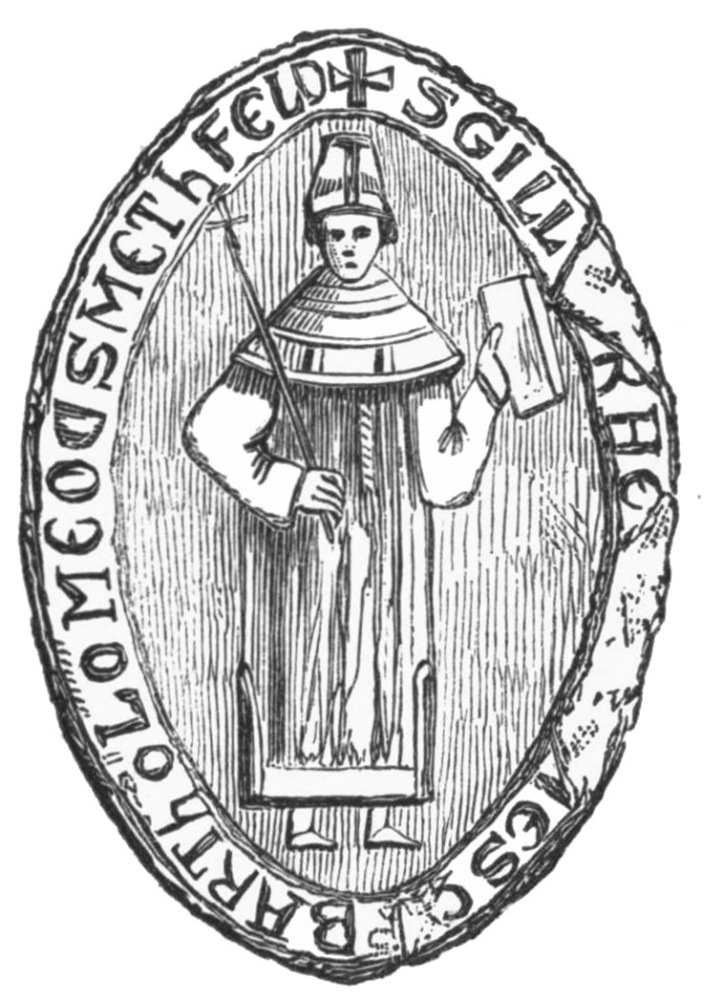
The earliest two seals, attached to a deed of 1137, show:i) (seal, left) Rahere as prior. Rahere is in typical prelate's pose - cross in right hand, Bible in left.  Inscription seems to be: SIGILL' RAE...IES C BARTHOLOMEO SMETHFELD
ii) (counterseal, right) a church with three towers.
Cf churches on the seals of Burscough and Canterbury, shown here. Legend:  [SIGILL]VM CONVENT. ECCLE. DI. ET S. BARTHOLOMEI DE SME[THFELD].  The two legends' lettering is very similar.  The seal and counterseal are depicted in an article from Archaeologia XIX (1817). 

The 12th-century hospital had its own seal (BM 3487), with St Bartholomew nimbed, right hand in benediction, left hand holding a cross crozier, and the inscription HOSPITALIS SANCTI [BART]HOLOME[I]. Normanus notes this seal ad causas (right) on a document from 1164, very similar to the description of the hospital's seal, but with the legend SIGILL' PRIORIS ET CONVENT' S BARTHOLI' LOND' AD CAUSAS.

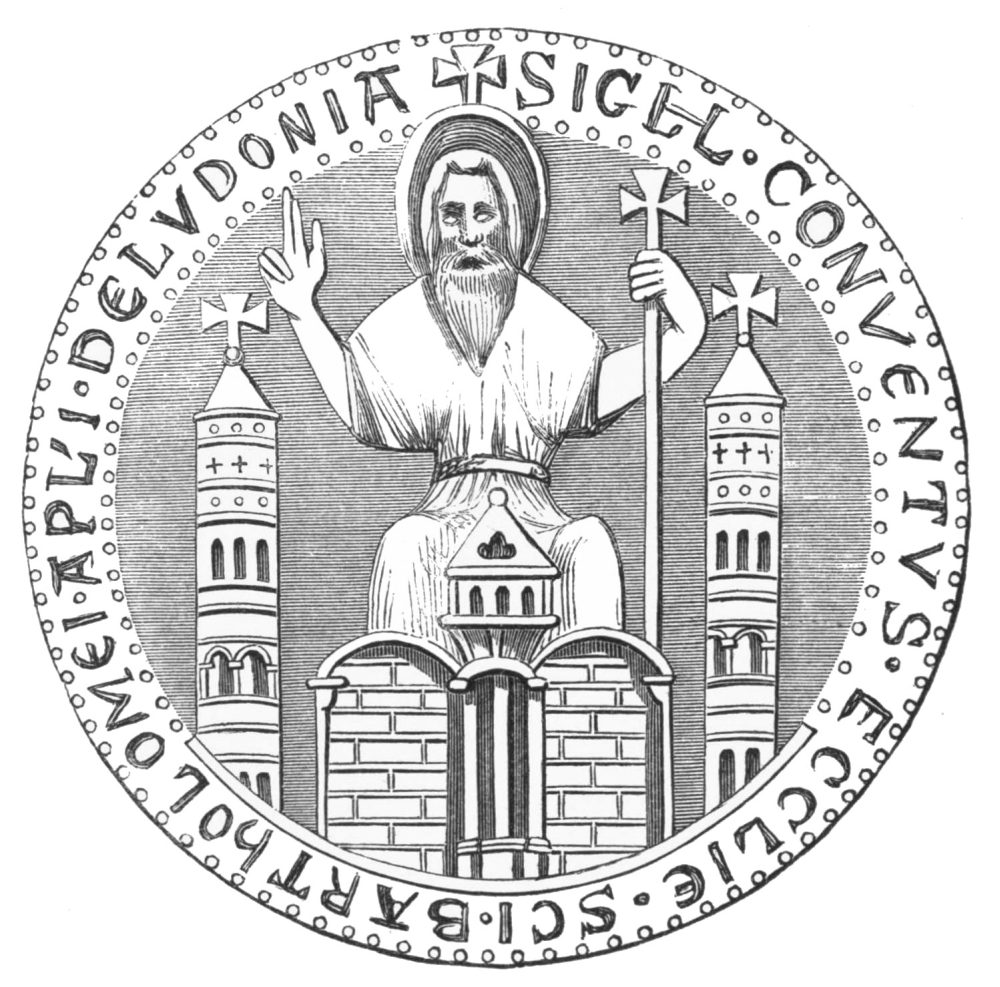
The late 12th/ 13th-century priory had a stonking seal and counterseal.  The seal (below) shows Bartholomew, cross in hand, sitting on or standing behind (I don't quite trust this illustration) a Norman church with two circular side towers.  This seal really reminds me of London's seal from 1219 (below Bart's seal), with St Paul brandishing his sword and pennon.  The Records of St Bart's says that the seal was on documents from 1198 to 1289, and it also notes a similarity between the circular towers here and those in the 12th-century counterseal. The legend is SIGILL · CONVENTVS · ECCLIE · SCI · BARThOLOMEI · APL'I · DE LVDONIA.


The counterseal is also noteworthy (BM 3489).  It's the 'navis ecclesiae', or ship of the church.  The church often appears as a ship  - indeed, the word 'nave' comes from 'navis' - which goes back to that special biblical ship, the ark.  (Here's a nice one at Lincoln.) The influential 12th-century Augustinian Hugh of St Victor wrote De Arca Noe (Of Noah's Ark), which could be found in monastic libraries up and down the land.  Coventry Cathedral Priory also had a ship or ark on its seal.  Here, the ark is a church on a fine hull, with three crosses (west and east end, and central tower), and an estoile and crescent (sun and moon) which is a feature of many seals of the period. A hand extends from the sinister side of the ship; it is clutching - I think - the dove, although that's not quite clear.  The legend: SIGILL': PRIORIS: ECCLESIE: SCI: BARTOLOMEI.


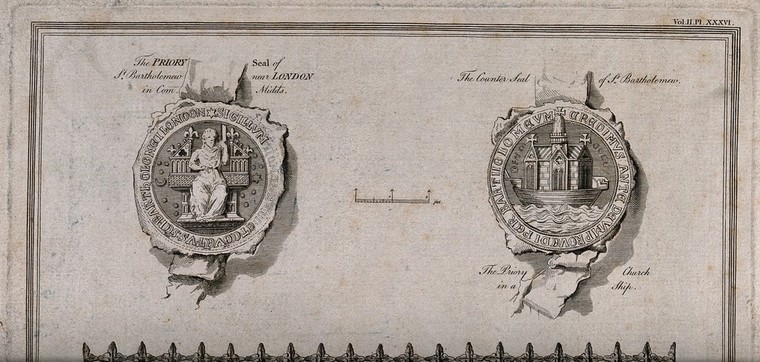
The sigillum commune, or common seal, of the Priory from c.1300 (BM 3492) has Bartholomew seated on a carved throne.  This 18th-century illustration is from the Wellcome Collection, which has it in excellent resolution.  The Records and Birch note a resemblance with the Great Seal of Edward I (illustration below, but there's a better one here).  Bartholomew has his flaying-knife where Edward has his orb, and a book (though not illustrated here) instead of Edward's sceptre.  It even has a beaded border like Edward's.  In addition, there's a moon and sun and two groups of three spots, and the legend reads: SIGILLVM COMMVNE PRIOR' ET CO[N]VE[N]TVS S[AN]C[T]I BARTHOLOMEI LONDON'.

The counterseal is another navis ecclesiae.  The church itself is a lovely bit of Early English, with three lots of two lancets, east and west end surmounted by trefoils, centre by a quatrefoil. It's a nice updating of the previous counterseal. The legend is a couplet such as was all the rage on episcopal counterseals: CREDIMVS: ANTE: DEVM: PROVEHI: PER: BARTHOLOMEVM ('we believe that we are brought before God through St Bartholomew'.)
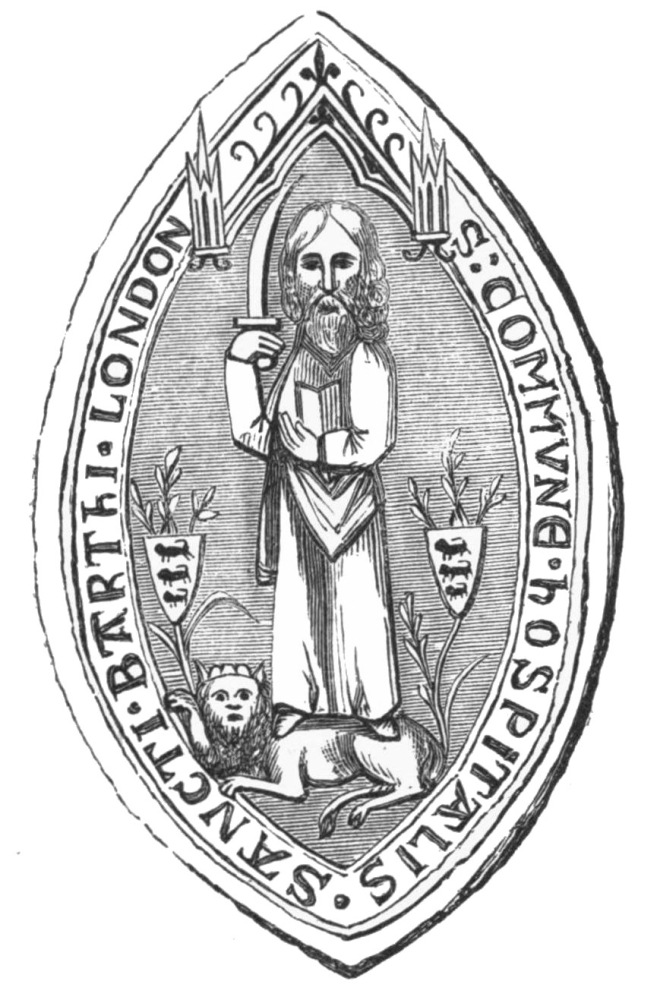
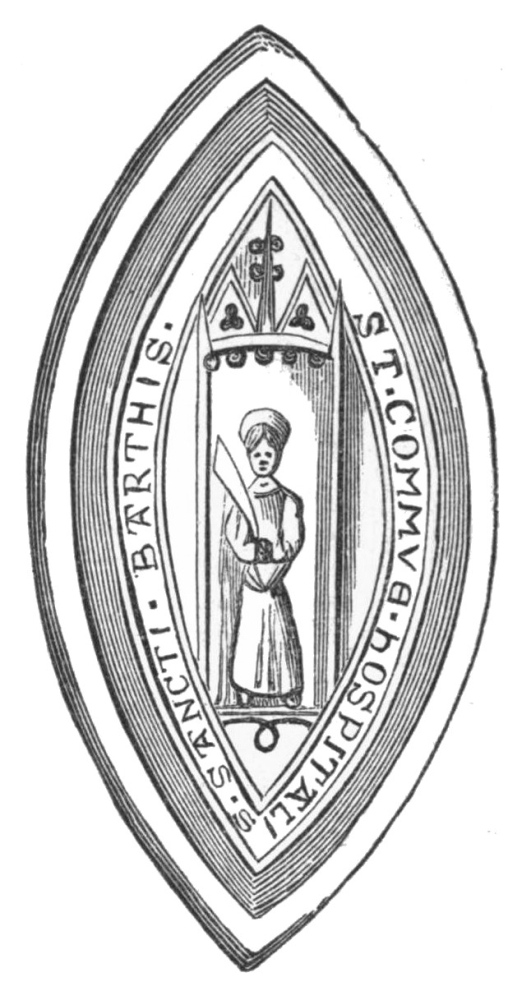
The hospital seal from around the same time is a pointed oval, with Bartholomew holding his knife and book. He has either side of him two saplings with shields hanging on them, with the English leopards on them, and he stands on a lion couchant guardant. Over his head is a trefoiled canopy, pinnacled and crocketed. Legend:  S: COMMUNE · hOSPITALIS · SANCTI · BARThI · LONDON.  A later version of this, on a document of 1529, is pictured right.

A 14th-century seal ad causas (BM 3495) is a pointed oval with Bartholomew standing on a corbel with a flaying knife in his hand and a cross crozier in his left. The legend is: [SIGILLUM PRIORIS] ET CONV[ENTUS SANCTI BAR]THOL'I LOND AD CAVS[AS].

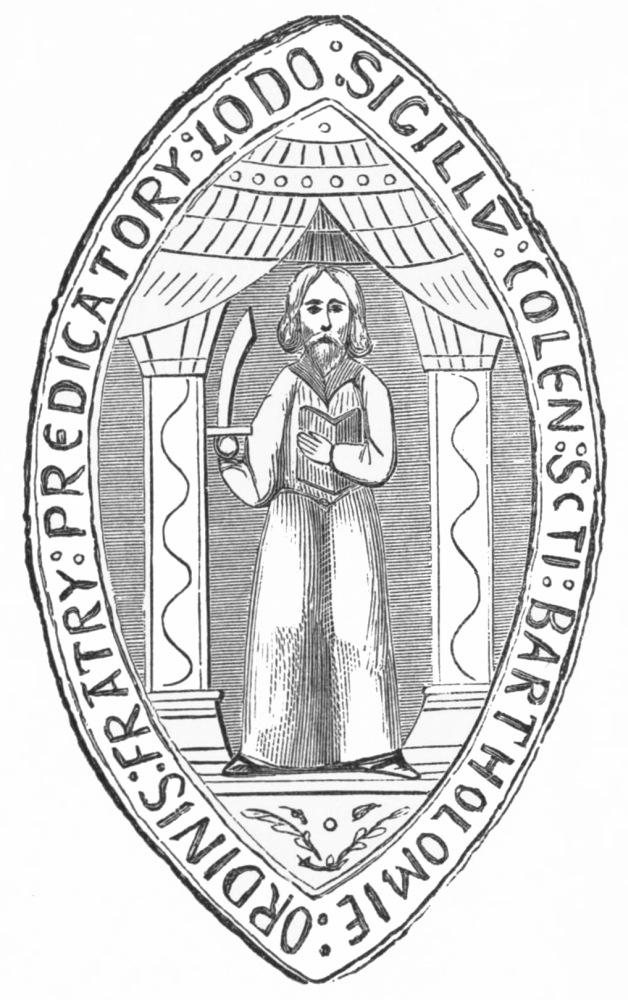
After the Dissolution, Mary I established a Dominican friary here. St Bartholomew holds his flaying-knife in his right hand and a book (the Bible) in his left, and stands under a renaissance canopy, between two columns and on a decorated corbel.  The legend reads SIGILLV: COVET: S'CTI: BARTHOLOMEI: ORDINIS: FRATRV: PREDICATORV: LODO:

Monday, June 22, 2020

SS Mary and Hardulph Breedon

The lovely chap who's spending his retirement blogging about Great English Churches has a good post on this one, so I'm not going to describe it (much), and he's got plenty of nice photographs.  There's another good post on Leicestershire Churches.

Photo: Archaeodeath
Breedon is one of a number of Austin priories with Anglo-Saxon foundations, like Bodmin or Plympton. (There's a whole thesis you can read on this here.)  Breedon was re-founded in the early 12th century with canons from Nostell, and seems to have been a cell of Nostell, with only as many canons as you could count on one hand.  But it kept its Anglo-Saxon minster sculpture, and its dedication to St Hardulph, though now, of course, accompanied by the BVM (although from the looks of this sculpture, she was already there!).

Hardulph was probably Eardwulf of Northumbria.

At some point, one of the priors tried to get independence for Breedon from Nostell.  He resigned.

Now, the seal (no picture, sorry).  An oval at 7/8 x 3/4", this seal is on the small side.  It's from 1377, and shows St Peter standing beside a tree, with a book in his right hand and two keys in his left hand.  I'm not quite convinced by Birch's transcription of the inscription - SAVN…PETR’ - I don't know what he thought 'savn' means, but I've not seen the seal, and he's usually pretty good.

I don't know any other depiction of St Peter standing by a tree.  I am, ahem, intreegued.