Search This Blog

Wednesday, August 5, 2020

Nostell

Almost as much remains of Nostell as it does of Merton; Merton is covered by a big supermarket, and Nostell by a big Georgian stately home - both signalling the change from religion to consumerism.  Nostell was, like Merton, one of the big founding priories, sending canons all over the place to establish other Austin houses. Nostell grew from a hermitage in St Oswald's Wood, near Pontefract, becoming an Austin house by 1120.  It was patronised by the de Lacy lords of Pontefract, and then Henry I; his archbishop of York, Thurstan, was quite possibly responsible for turning it into an Austin priory.  (The Borthwick Institute says J. A. Frost's useful booklet on Nostell is out of print; you can find the first 9 pages here.)  Nostell soon grew to be one of the top three northern Austin priories.

Left is the priory seal from the early 12th century.  It shows St Oswald, with a crown which looks unfortunately like a jester's hat.  He is seated on a throne with nice wolf-head ends, and he holds an orb and sceptre.  The legend:  SIGILLVM [SCI] OSWALD' REGIS & M DE NOSTELT

Oswald was a 7th-century king of Northumbria who promoted Christianity. He gave Aidan, the 'Apostle of Northumbria', Lindisfarne as the centre of his bishopric.  Oswald he was killed in battle with the Mercians, and his body cut into pieces and put on spikes.  Miracles of course occurred where he died.  Oswald's head was buried in Durham Cathedral (although several rival heads exist elsewhere), and one of his arms turned up at Peterborough, where monks would guard it continuously to stop relic-theft.  In the feretory at Durham, you can see a late-medieval statue of St Cuthbert holding St Oswald's head.

The counterseal, from later in the century, shows the BVM and Child on her lap. She holds, as Charles Clay said, 'an object in either hand'.  It's difficult to make out those objects, but the right-hand one will be a sceptre, because it usually is.  The legend is +  CONTRASIGILL' SANCTI OSWALDI DE NOSTLE:

A further, 13th-century, seal exists (in the National Archives), possibly the privy seal or ad causas; I don't have a picture, but Clay's description is: Round, 1 in. The Virgin and Child, half-length, between four large pointed leaves. * MARIA MA…….ENA.
Prior Robert de Quixley (1393-1427), who had the history of the Priory compiled (the legend of the Priory, anyway), had a nice seal (left).  It has two tiers. In the upper, St Oswald, seated on a throne, holds a sceptre between two clergy with croziers. Below, Robert himself, vested for mass, stands between two canons. The legend has a couplet feel about it, but it's very incomplete.  …RO…[?RI]ORIS [?SCI]…RE[?GIS MAR]T….T…

Two more prior's seals are described by Clay:
1) John de Huddersfield (c.1427): oval, 'on the breast of a splayed eagle a shield with some floral device, flattened by pressure.  ...ERhO...
2) a 15th-century prior:  pointed oval, 'beneath an elaborately pinnacled and buttressed canopy a seated figure of St. Oswald the King, robed, holding two sceptres; in base, beneath a four-centred arch, a praying canon; on either side of the arch a shield of arms, dexter, a fess between [?] three lions rampant; sinister, much rubbed; legend broken away.

Tuesday, August 4, 2020

Bart's

Photo: Christopher Fowler
St Bartholomew the Great, Smithfield, was founded by one of Henry I's chaplains, Rahere.  He fell ill, and, fearfully, vowed that if he recovered, he'd found a hospital. Presumably in some delirium, he was visited in a dream by St Bartholomew, who promised that if he founded a church in Smithfield, he would recover.  Rahere recovered, and therefore founded a church - an Austin priory, with a hospital attached.  You can read more about the hospital here.  Rahere died in 1145, and was buried in the church he founded and had been prior of.  Here he is (in a slightly later tomb).


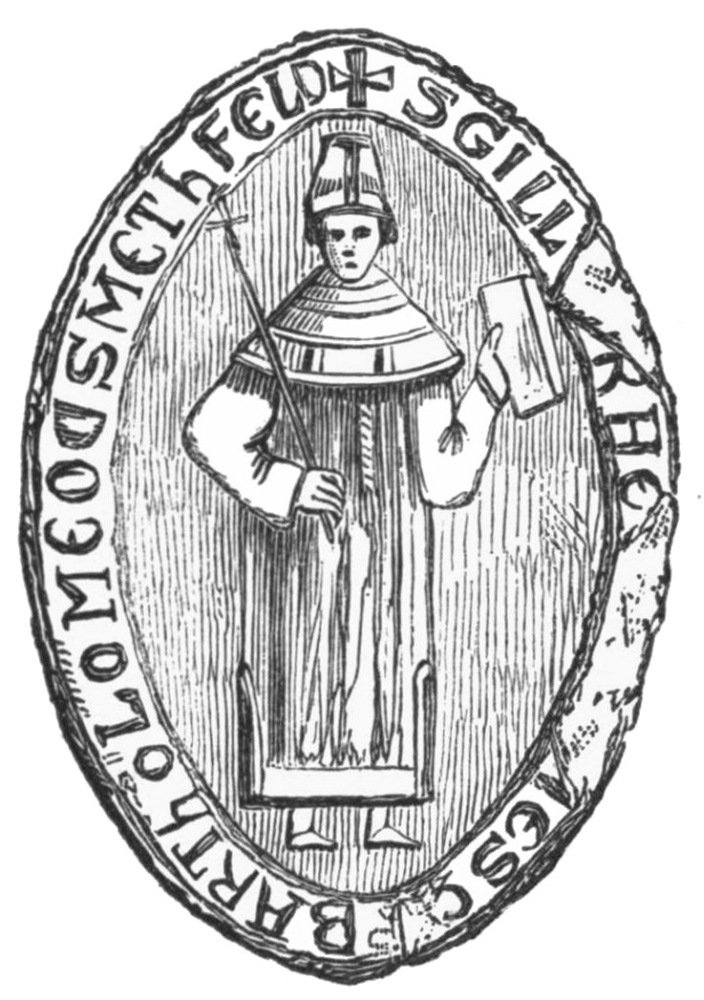
The earliest two seals, attached to a deed of 1137, show:i) (seal, left) Rahere as prior. Rahere is in typical prelate's pose - cross in right hand, Bible in left.  Inscription seems to be: SIGILL' RAE...IES C BARTHOLOMEO SMETHFELD
ii) (counterseal, right) a church with three towers.
Cf churches on the seals of Burscough and Canterbury, shown here. Legend:  [SIGILL]VM CONVENT. ECCLE. DI. ET S. BARTHOLOMEI DE SME[THFELD].  The two legends' lettering is very similar.  The seal and counterseal are depicted in an article from Archaeologia XIX (1817). 

The 12th-century hospital had its own seal (BM 3487), with St Bartholomew nimbed, right hand in benediction, left hand holding a cross crozier, and the inscription HOSPITALIS SANCTI [BART]HOLOME[I]. Normanus notes this seal ad causas (right) on a document from 1164, very similar to the description of the hospital's seal, but with the legend SIGILL' PRIORIS ET CONVENT' S BARTHOLI' LOND' AD CAUSAS.

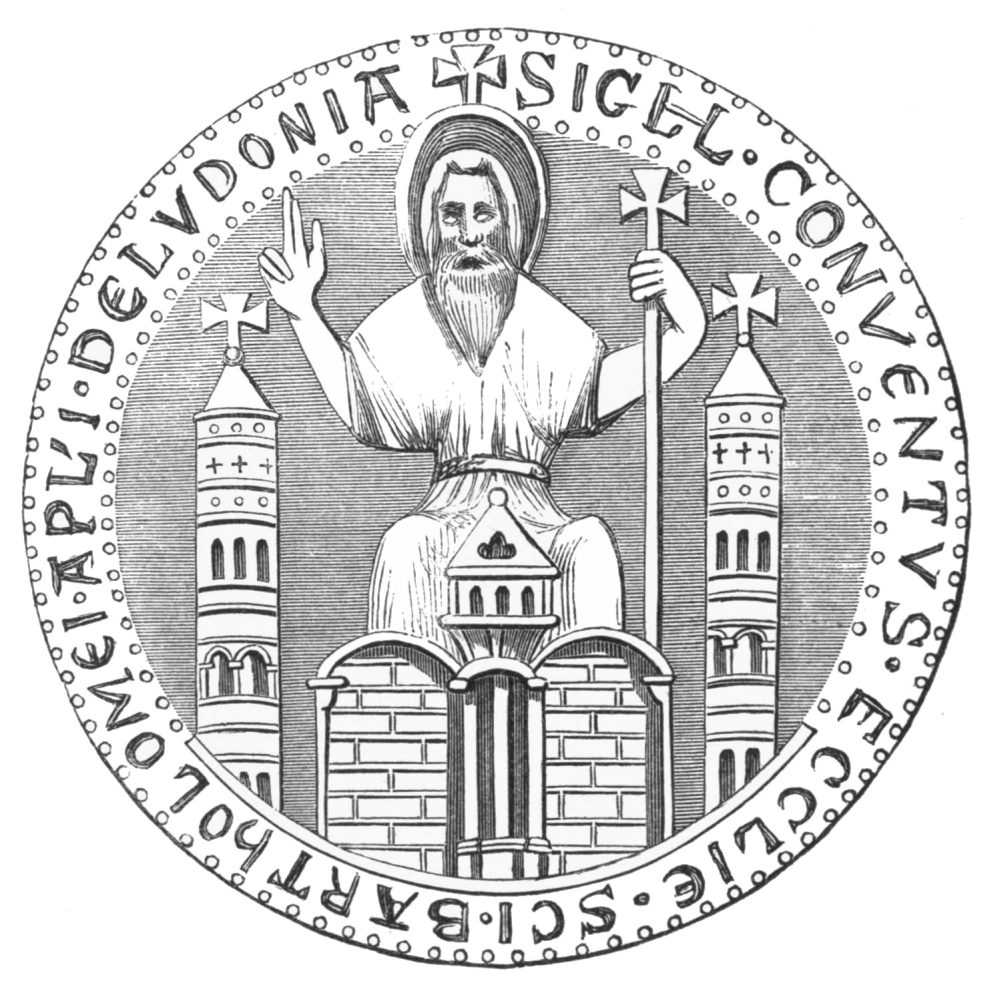
The late 12th/ 13th-century priory had a stonking seal and counterseal.  The seal (below) shows Bartholomew, cross in hand, sitting on or standing behind (I don't quite trust this illustration) a Norman church with two circular side towers.  This seal really reminds me of London's seal from 1219 (below Bart's seal), with St Paul brandishing his sword and pennon.  The Records of St Bart's says that the seal was on documents from 1198 to 1289, and it also notes a similarity between the circular towers here and those in the 12th-century counterseal. The legend is SIGILL · CONVENTVS · ECCLIE · SCI · BARThOLOMEI · APL'I · DE LVDONIA.


The counterseal is also noteworthy (BM 3489).  It's the 'navis ecclesiae', or ship of the church.  The church often appears as a ship  - indeed, the word 'nave' comes from 'navis' - which goes back to that special biblical ship, the ark.  (Here's a nice one at Lincoln.) The influential 12th-century Augustinian Hugh of St Victor wrote De Arca Noe (Of Noah's Ark), which could be found in monastic libraries up and down the land.  Coventry Cathedral Priory also had a ship or ark on its seal.  Here, the ark is a church on a fine hull, with three crosses (west and east end, and central tower), and an estoile and crescent (sun and moon) which is a feature of many seals of the period. A hand extends from the sinister side of the ship; it is clutching - I think - the dove, although that's not quite clear.  The legend: SIGILL': PRIORIS: ECCLESIE: SCI: BARTOLOMEI.


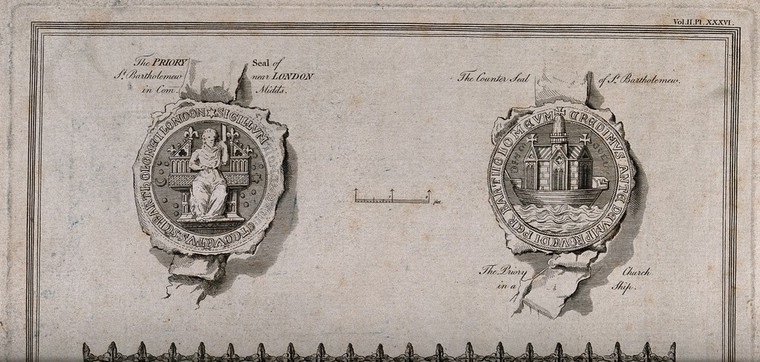
The sigillum commune, or common seal, of the Priory from c.1300 (BM 3492) has Bartholomew seated on a carved throne.  This 18th-century illustration is from the Wellcome Collection, which has it in excellent resolution.  The Records and Birch note a resemblance with the Great Seal of Edward I (illustration below, but there's a better one here).  Bartholomew has his flaying-knife where Edward has his orb, and a book (though not illustrated here) instead of Edward's sceptre.  It even has a beaded border like Edward's.  In addition, there's a moon and sun and two groups of three spots, and the legend reads: SIGILLVM COMMVNE PRIOR' ET CO[N]VE[N]TVS S[AN]C[T]I BARTHOLOMEI LONDON'.

The counterseal is another navis ecclesiae.  The church itself is a lovely bit of Early English, with three lots of two lancets, east and west end surmounted by trefoils, centre by a quatrefoil. It's a nice updating of the previous counterseal. The legend is a couplet such as was all the rage on episcopal counterseals: CREDIMVS: ANTE: DEVM: PROVEHI: PER: BARTHOLOMEVM ('we believe that we are brought before God through St Bartholomew'.)
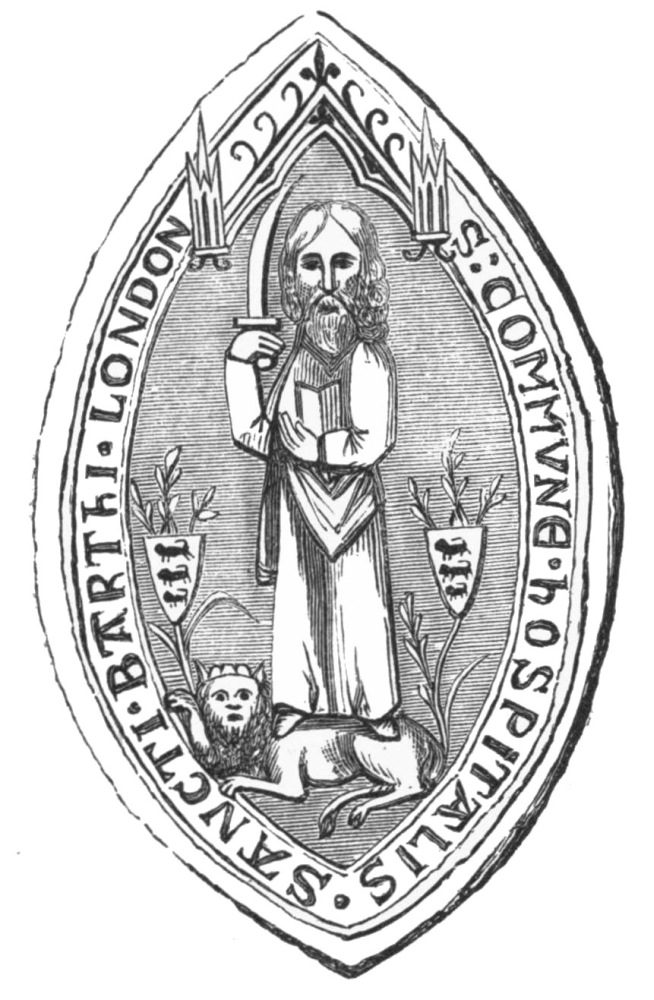
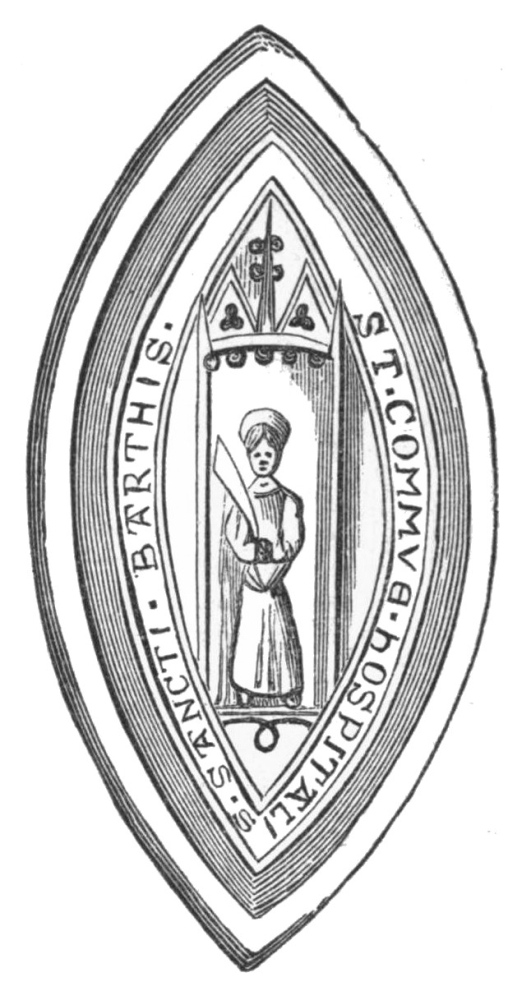
The hospital seal from around the same time is a pointed oval, with Bartholomew holding his knife and book. He has either side of him two saplings with shields hanging on them, with the English leopards on them, and he stands on a lion couchant guardant. Over his head is a trefoiled canopy, pinnacled and crocketed. Legend:  S: COMMUNE · hOSPITALIS · SANCTI · BARThI · LONDON.  A later version of this, on a document of 1529, is pictured right.

A 14th-century seal ad causas (BM 3495) is a pointed oval with Bartholomew standing on a corbel with a flaying knife in his hand and a cross crozier in his left. The legend is: [SIGILLUM PRIORIS] ET CONV[ENTUS SANCTI BAR]THOL'I LOND AD CAVS[AS].

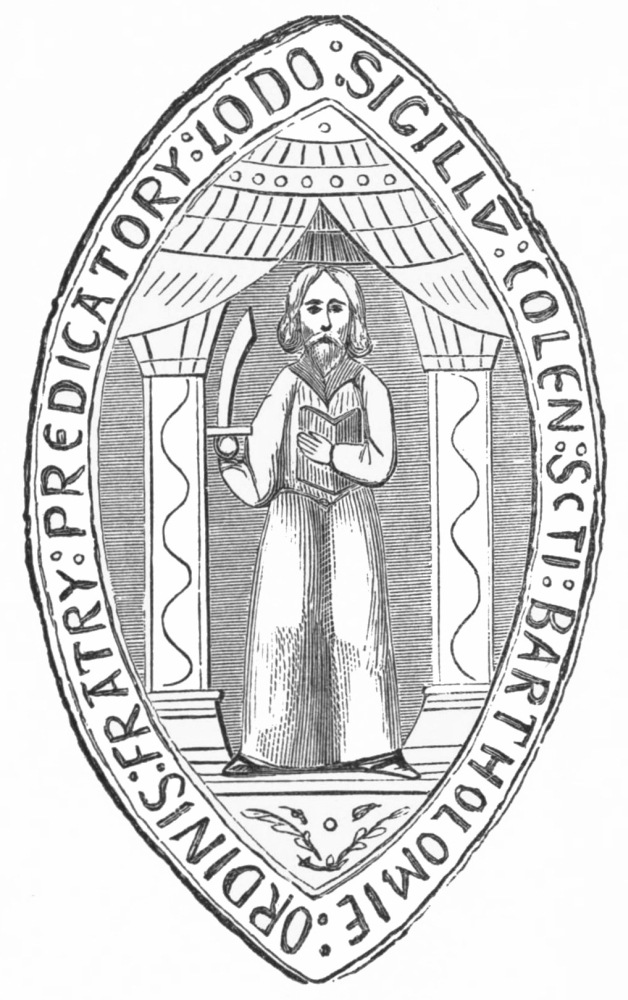
After the Dissolution, Mary I established a Dominican friary here. St Bartholomew holds his flaying-knife in his right hand and a book (the Bible) in his left, and stands under a renaissance canopy, between two columns and on a decorated corbel.  The legend reads SIGILLV: COVET: S'CTI: BARTHOLOMEI: ORDINIS: FRATRV: PREDICATORV: LODO:

Monday, June 22, 2020

SS Mary and Hardulph Breedon

The lovely chap who's spending his retirement blogging about Great English Churches has a good post on this one, so I'm not going to describe it (much), and he's got plenty of nice photographs.  There's another good post on Leicestershire Churches.

Photo: Archaeodeath
Breedon is one of a number of Austin priories with Anglo-Saxon foundations, like Bodmin or Plympton. (There's a whole thesis you can read on this here.)  Breedon was re-founded in the early 12th century with canons from Nostell, and seems to have been a cell of Nostell, with only as many canons as you could count on one hand.  But it kept its Anglo-Saxon minster sculpture, and its dedication to St Hardulph, though now, of course, accompanied by the BVM (although from the looks of this sculpture, she was already there!).

Hardulph was probably Eardwulf of Northumbria.

At some point, one of the priors tried to get independence for Breedon from Nostell.  He resigned.

Now, the seal (no picture, sorry).  An oval at 7/8 x 3/4", this seal is on the small side.  It's from 1377, and shows St Peter standing beside a tree, with a book in his right hand and two keys in his left hand.  I'm not quite convinced by Birch's transcription of the inscription - SAVN…PETR’ - I don't know what he thought 'savn' means, but I've not seen the seal, and he's usually pretty good.

I don't know any other depiction of St Peter standing by a tree.  I am, ahem, intreegued.

Saturday, June 20, 2020

Grace Dieu

While we're on extraordinary women (see last post on the Elas Longspées), let's look at Rohesia de Verdun, founder of Grace Dieu, north-west of Leicester.

Photo: de-verdon.uk
Roesia de Verdun (d.1247) was the heir to a not-insignificant house, and therefore was quite eligible.  Shewas married first (it seems) to Nicholas de Beaulieu (whoever he was) or was it William Perceval de Somery (whoever he was)?  Different sources say different things.  But they agree on her second husband, Theobald Butler of Ormond.  This marriage was Henry III's particular request.  Roesia bore Theobald five children, but the fact that she shelled out 700 marks on his death to remain a femme sole suggests that marriage didn't agree with her - or else that she was determined to hold on to her estates. And here's an interesting thing about her - like Ela II, she kept her family name.  As sole heiress, she also kept the family estates, which she passed on to her son John.

In the 1230s, Roesia built Castle Roche, Co. Louth.  She reportedly defenestrated the master mason towards the end of the project, so that he'd not be able to divulge the secrets of its unique construction, but that no doubt is misogynist hogwash.

In the late 1230s, she established Grace Dieu, and had retired there by 1242, dying only in her mid-forties in 1247.

A couple of years later, Adam Marsh, perhaps at the behest of his friend Mr Thomas de Verdun (relationship to Roesia not clear), wrote to the Bishop of Lincoln and others to make sure that the convent was adequately founded and provided for.  And it seems to have been.  It attracted other benefactions in the 14th century; by the 15th, there were 14 nuns (it's not unlikely that this number was fairly stable throughout), with two dozen male servants and a handful of female ones.  The nuns' clothing allowance was worth 6s. 8d., so a couple of stones of wool per year, or a couple of hundred quid in today's money.

And now, the seals.  Alas, no pictures (yet).  The 13th-century priory seal is a pointed oval: Christ, on a throne, under a trefoiled canopy supported on slender shafts; right hand in benediction; left hand holds a book. In base, under a trefoiled arch, female figure (the founder) kneeling and holding a charter.
SIGILL' CONVENT' . . . . ALVE DE GRATIA . . .

Theobald de Verdun
This charter is a lovely touch. I've not come across other such charter-bearers, although I'm sure that the unique Roesia can't be unique here.
Roesia's own seal:  she stands in a tunic of the Verdun arms (fretty), holding two shields, one being the Verdun arms. The other has, apparently, an indenty fess; possibly Butler. (I’ve not seen this seal). Nigel Tringham describes another seal, in which ‘she holds a burning lamp in her right hand’.

By the way, the second prioress of Grace Dieu was Alice de Gresley.  Her seal, from 1269, has the BVM on a throne, Child on left knee, under a trefoiled canopy supported on slender shafts. At the sides of her head, dexter, a crescent, sinister, an estoile. In base, under an arch, the prioress kneeling in prayer.


Thursday, June 18, 2020

Ela Longspée and Ela Longspée

I belong to a web group that occasionally posts 'silly plurals', and here's one for them, I think.  We have here two outstanding women, mother and daughter, both called Ela.  Are they the Ela Longspées, the Elas Longspée, the Elas Longspées?

The first Ela was Countess of Salisbury, and founder of Lacock Abbey.  The second, her daughter, was Countess of Warwick, a patron of Walter of Merton's college at Oxford, and was buried in Oseney Abbey.  Both women were, therefore, patrons and benefactors of the Augustinians.  (L. L. Gee has written about women as Austin patrons, and Emilie Amt has written about Ela II.)  So they can both quite happily appear here!  Let's look at their seals and counterseals.


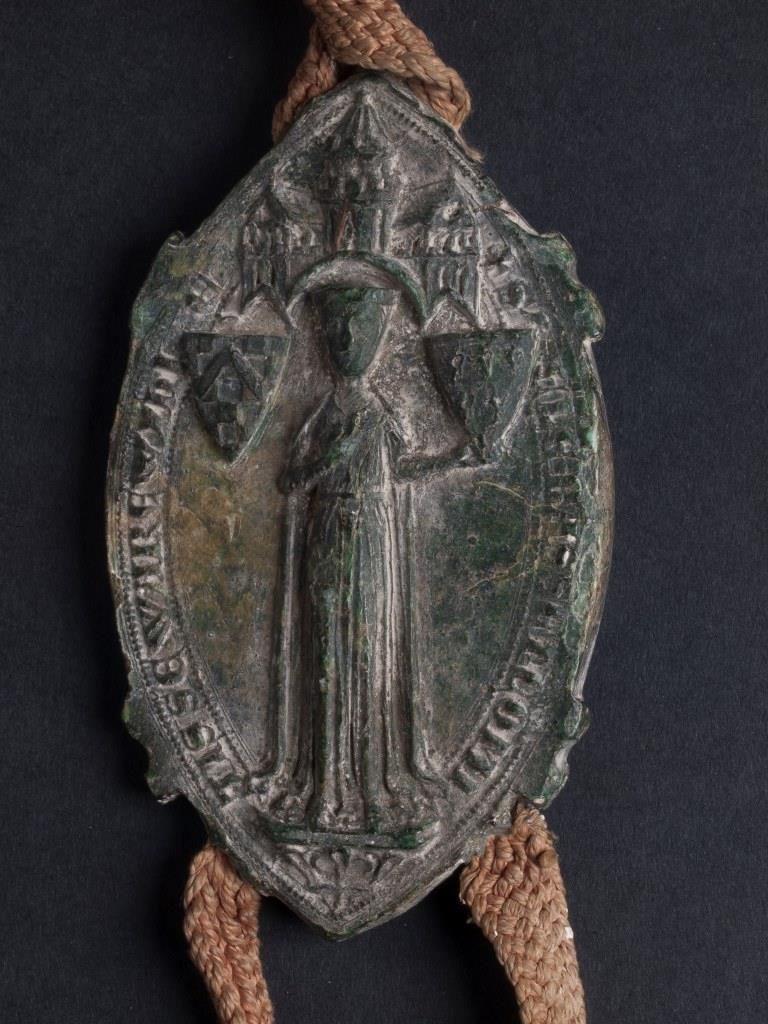
 These make for a good spot-the-difference.  They are not dissimilar to that of Joan de Munchensy, Countess of Pembroke, who holds a hawk. Joan's background is plain; Ela is surrounded by .  What, if anything, the hawk signifies is discussed elsewhere, but the figure's dynamic-but-elegant pose is worth noting.  Ela I stands between two lions, not so much rampant as climbing the walls.  (Perhaps they're after the bird.)  She stands on a nice corbel.  Her daughter also has a nice corbel, and instead of rampant lions, she has a couple of rampant ramblers.

The counterseals:  both heraldic, showing that the shield had already gone from primarily military to a proclamation of lineage.  Ela I's has the six lions rampant of Longspée.  Ela II has two lions passant above and below her shield, which is encased in a hexafoil.  It has the six lions rampant, and the inscription shows that although she's Countess of Warwick, she's still a Longspée.  It wasn't common for women to keep their names, but not unknown, especially when the woman was descended from people like Ela's parents...  She was Longspée and proud.

Ela's second seal is more mid-to-late century in style, with a church-style canopy.  She stands on a fleur-de-lys corbel.  The three shields on seal and counterseal are hers and her husbands'.  Thomas Beauchamp, Earl of Warwick is dexter on the seal; she holds, sinister, her Longspée shield; the counterseal is Philip Bassett.  Again, the counterseal arms are encased in a foil, this time a quatrefoil, with dainty trefoils at the corners, and between two lions rampant.


Another image of Ela II's seal is here, from the Merton College archives.


Plympton


Image result for plympton priory seal
From Monasticon Dioesis Exoniensis (1846)
Bishop William Warelwast of Exeter was on a drive to improve the standards of canons in his diocese. In 1121 he disbanded the secular college founded by the Anglo-Saxons and instituted an Augustinian house, the Priory of St Peter and St Paul, using canons from Holy Trinity, Aldgate, and Merton Priory.  It's probable that one of those Merton canons was a chap called Geoffrey, who in 1130 or so became prior.  The history of Plympton is here, and de Gray Birch's description of the seals here.

The priory seal is 13th-century.  Peter and Paul sit on a bench or throne, with beaded nimbus and books, and their symbols.  They sit atop a lovely carved corbel of foliage.  The inscription Birch notes as

SIGILLVM : ECCLESIE : AP'LOR …..RI : ET : PAVLI : DE : PLIMTONA.

But surely that must be A PRIORATU SANCTE PETRI ET PAVLI.

He describes its counterseal - BVM, crowned and throned, the Child on left knee; in right hand an orb topped with a fleur-de-lis on which a bird perches.  + SIGNVM : SANCTE : MARIE : DE : PLIMTONA.  Mary was the most popular saint for Austin houses. 

Continuing the Marian theme, Prior Richard de Tregony's seal (1280) has a half-length BVM, with Child on left arm, under an arch of five cusps; below, two quadrilobes containing on the left, St Paul's bust, with a sword and over the head an estoile; on the right, St Peter's, with keys and over the head a crescent. In base, under a pointed and trefoiled arch, the Prior, kneeling in prayer.  The quadrilobes sound very similar to the windows on Merton's seal. Merton held land in Tregony, and indeed its prior in the 1290s was Nicholas Tregony - perhaps some relation to Richard.  I'll try to get a picture of this seal.

Plympton's seal, I feel, needs the caption 'And it's goodnight from him...'

Wednesday, June 17, 2020

Gresley

Photo: Wikipedia
It's the trademark of Austin priories that they are of infinite variety, and Gresley is a bit different to some in that it was really very attached to its patrons, the Gresley family.  Gresley Priory was founded by William de Gresley, son of Nigel de Stafford, sometime during Henry I’s reign.  William lived in the castle in Gresley, and now the village is Castle Gresley.  His priory gave Church Gresley its name.

The Gresleys gave to the priory throughout the 12th and 13th centuries – for example, in 1291, Geoffrey de Gresley gave the priory land in return for a canon to sing mass for the soul of Agnes his wife.  Gresley wasn’t a rich priory:  its temporalities and spiritualities were valued in 1291 at £9 6s. 3½d  – according to the National Archives’ currency converter, that’s around £6,848 in today’s money. In 1339, the priory was claiming poverty as a reason to appropriate a church.  By the 16th century, they were doing a bit better, but not much – the Valor Ecclesiasticus (1535) calculated the priory’s T and S as £39 13s 8d, around £17,511 today.

Unusually, the Priory's dedicatee is St George (the church is also to St Mary, who is the usual Austin dedicatee, so I presume it was a double dedication).  Samuel Pegge, in his Observations on the History of St George (Archaeologia, 1777) noted:

William, son of Nigel de Greisley, dedicated the Priory of Canons at Greisley, in the county of Derby, to St. Mary and St. George, in the reign of king Henry I. The seals of this religious foundation are extant in drawings in a MS. Chartulary of the library at Manchester, one with the Equestrian figure of St. George alone, inscribed Sigillum Prioratus Sti. Georgii de Greseley, and another with the same type, and the Dragon underneath, whereof the Legend is Sigillum Coventus Sti. Georgii de Greseley. The first of these seals belongs plainly, as appears from the instrument it hangs to, to the reign of Henry II. or Richard I. and the latter to the year 1420.  It appears to me from a deed sans date, and from another of 19 E. I. in the same Cartulary, that the family Greisley, which is indeed very ancient, made use of the same device on their seals; whence it would seem, that they regarded St. George as the peculiar Patron and Advocate of their house; and, that the Saint was, commonly, represented here in the 12th and 13th century on horseback.
Photo: British Museum
We've had priory seals aping episcopal seals (Merton, Drax); this seems to be one aping the equestrian seal!  This matrix shows Robert FitzWalter (d.1198), and he even has a pet dragon (and lots of heraldry, the new fashion).

The progenitor of the Gresley line (and I use this word deliberately, as you’ll see) was called Nigel, and it’s a forename that carried on certainly into the 20th century.  The most famous Gresley nowadays is Nigel, designer of the Mallard and the Flying Scotsman.  Both of which used many seals of a different sort.
Photo: Hugh Llewelyn/ Wikipedia