There's nothing left of Ravenstone Priory - and not even an entire seal, either. I don't yet have a picture of it. The BM copy dates from the priorate of Ralph (second or third prior, 1275-1309), as his seal is the counterseal. Ravenstone's seal is a pointed oval with the BVM seated on a carved throne. Ralph's seal also has the BVM, but half-length, under a trefoiled arch, the Child on her left knee. If these sound familiar, it's not so much that Ravenstone Priory was dedicated to the BVM (like most Austin priories), but because there is some connexion with Merton Priory, of which more below. Back to the obverse. Underneath the BVM is a trefoiled arch with carved spandrils, and
central pillar; on the left a woman kneels and holds up what Birch describes as 'an indistinct
object'. The right-hand figure is missing. The inscription is . . . G • D RAVENES. Ralph's seal has him kneeling in prayer, in base, under a quadrilobe with arched spandrils. RADVLPHI • PRIORIS D RAVE ...
The Priory was founded by Peter Chaceporc, keeper of the royal wardrobe. He's one of those really rather important chaps of whom not terribly much is known (see, as usual, the Oxford DNB). The VCH says Ravenstone was founded 'about1255' by him, and 'after the death of Peter the patronage of the house reverted to the Crown, and
the canons were bound to sing a certain number of masses for the soul
of the king as founder.' But elsewhere the VCH says that the canons celebrated the souls of Peter and his uncle Hugh de Vivon, so it's a bit confusing. The charter, quoted in Dugdale, says that Hugh Chaceporc, Peter's big brother and executor, bought the necessary land off Saher de Wahull; Henry confirmed the land and co-founded the priory.
Ravenstone was never rich, but it had enough money to support some canons to be, essentially, a chantry. It owned half a knight's fee and the parish church. At its dissolution, in 1524, it had only two canons; it is doubtful whether even at its height there were many more than a handful.
Peter shared the manor of Ravenstone with the Crown, having rented his half off Saher de Wahull for - delightfully - a pair of gilt spurs. Part of the priory land is now two rows of almshouses, built in the 17th century.
Now, the Merton connexion. Matthew Paris says:
'On the third day before the Nativity [1255], the same Peter made his will. And amongst other things, he left 600 marks for to provide land, in England, where lands were more able and ready to be bought, and there to have built a monastic church, viz. of canons regular, coming from the house of Merton, and there God would be served with grace and honour, and sacrifice offered everyday to God for his soul and the souls of all the faithful.’
Ravenstone was this priory. Dugdale gives the first prior as 'William de Divisis' (Devizes), but the VCH gives the first prior as Adam of Wymondley (resigned 1275). Wymondley is between Stevenage and Letchworth, so not too far from Ravenstone. Merton held lands around there, for example in Kimpton. Merton held lands near Chippenham, which isn't that far from Devizes, but it's not especially near. Merton did have a canon called Roger of Deveneis (Devonish) in 1239. There are no records of either Adam or William at Merton, but we don't know even nearly half the brethren there! We also don't know for sure that Merton supplied the first canons of Ravenstone, but there's no reason to think not: that was Peter's wish, and Merton had supplied plenty of priories in the previous century - and Henry III was involved (he seems to have been a co-founder), and Merton was heavily involved with Henry. Indeed, Peter's colleague in government, John Mansel, also founded an Augustinian priory, at Bilsington, with Merton canons. John was one of the witnesses to the charter of Ravenstone.
Wednesday, April 29, 2020

Friday, April 3, 2020
Bilsington
The reason for this post is not so much the seal as just sorting out a few Merton-related things.
Bilsington Priory was founded in 1253 by John Mansel. In 1261, Merton Priory confirmed that it had no jurisdiction over the house or its priors, despite the first three priors having come, at Mansel's request, from Merton (Heales, p.137-8). This third prior was R. de South Malling. The first prior was William. The VCH records, from the Close Rolls of Edward III, one Walter as the second prior (c.1255), and we can add R. de South Malling (c.1261 probably till 1276). In 1276, Merton's links with Bilsington's priors seem to have ended, as John Romenale was, according to VCH, a canon of Leeds Priory.
I don't have a picture of the seal, but it sounds a nice one. It's from the 14th century, and is a pointed oval. W. de Gray Birch describes it thus: "in an elegantly carved niche with three trefoiled canopies, pinnacled and crocketed, the coronation of the Virgin, an angel issuing from above and placing the crown on her head. Background diapered. In base, under an arcaded corbel, the founder, John Mansell, Provost of Beverley, turned to the r. h., holding a model of the Church ; and a group of kneeling canons. SIGILLVM • COMMVNE • ECCLESIE • SANCTE • MARIE • DE • BILSINGTONE."
The Coronation of the Virgin can be seen on Anthony Bek's seal, which will have to do for you until I get to snap this one. She's being crowned on the counterseal (the reverse); Bek himself is enthroned on the obverse, between SS Oswald and Cuthbert.

(By the way, I see there's an Anthony Bek Nursery and Primary School. What do they teach them? Profligacy? Hypocrisy? War-mongering?! By the way, too, I nicked these photos from the Age of Chivalry book, which is no longer in print, being a catalogue from an exhibition in the '80s, but which is really rather nice and defo worth having on your book shelf or coffee table if you can find a copy.)
Like Combwell, Bilsington is now a wedding venue. They seem to call it St Augustine's, but it was actually St Mary's - perhaps they're confusing it with being an Augustinian priory?
I'm just going to dump the list of witnesses to the foundation here, in case I need them later.
Bilsington, witnessed by Boniface, William, Bishop of Salisbury, Peter d’Aigueblanche (Hereford), Richard of Gloucester, Peter of Savoy, Peter Chaceporc, AD of Wells, Mr Wm Kilkenny, AD Coventry, Ralph Fitz Nicholas, John Grey, Bertam Cricel, John de Lexington, Robert Walerand, William de Lichfield, canon of London, Mr John Clarel, Geoffrey de Childerwick, Richard de Tilbury, Alard Fleming, Thomas de Colchester, Simon de Huntingdon, chaplain, and many others. 1253, June.
Bilsington Priory was founded in 1253 by John Mansel. In 1261, Merton Priory confirmed that it had no jurisdiction over the house or its priors, despite the first three priors having come, at Mansel's request, from Merton (Heales, p.137-8). This third prior was R. de South Malling. The first prior was William. The VCH records, from the Close Rolls of Edward III, one Walter as the second prior (c.1255), and we can add R. de South Malling (c.1261 probably till 1276). In 1276, Merton's links with Bilsington's priors seem to have ended, as John Romenale was, according to VCH, a canon of Leeds Priory.
I don't have a picture of the seal, but it sounds a nice one. It's from the 14th century, and is a pointed oval. W. de Gray Birch describes it thus: "in an elegantly carved niche with three trefoiled canopies, pinnacled and crocketed, the coronation of the Virgin, an angel issuing from above and placing the crown on her head. Background diapered. In base, under an arcaded corbel, the founder, John Mansell, Provost of Beverley, turned to the r. h., holding a model of the Church ; and a group of kneeling canons. SIGILLVM • COMMVNE • ECCLESIE • SANCTE • MARIE • DE • BILSINGTONE."
The Coronation of the Virgin can be seen on Anthony Bek's seal, which will have to do for you until I get to snap this one. She's being crowned on the counterseal (the reverse); Bek himself is enthroned on the obverse, between SS Oswald and Cuthbert.

(By the way, I see there's an Anthony Bek Nursery and Primary School. What do they teach them? Profligacy? Hypocrisy? War-mongering?! By the way, too, I nicked these photos from the Age of Chivalry book, which is no longer in print, being a catalogue from an exhibition in the '80s, but which is really rather nice and defo worth having on your book shelf or coffee table if you can find a copy.)
Like Combwell, Bilsington is now a wedding venue. They seem to call it St Augustine's, but it was actually St Mary's - perhaps they're confusing it with being an Augustinian priory?
I'm just going to dump the list of witnesses to the foundation here, in case I need them later.
Bilsington, witnessed by Boniface, William, Bishop of Salisbury, Peter d’Aigueblanche (Hereford), Richard of Gloucester, Peter of Savoy, Peter Chaceporc, AD of Wells, Mr Wm Kilkenny, AD Coventry, Ralph Fitz Nicholas, John Grey, Bertam Cricel, John de Lexington, Robert Walerand, William de Lichfield, canon of London, Mr John Clarel, Geoffrey de Childerwick, Richard de Tilbury, Alard Fleming, Thomas de Colchester, Simon de Huntingdon, chaplain, and many others. 1253, June.
Thursday, April 2, 2020
Combwell
This is a special seal. The Priory was dedicated to Mary Magdalene, and despite its being reduced from abbatial status to a priory in the early 13th century because it wasn't rich enough, it still managed to afford this seal!

Mary M was conflated in the early Middle Ages with the person whom Christ drove devils out of, and with a prostitute whom he befriended. She became the sinner's sinner, and was hugely popular in the 12th and 13th centuries, partly because of a fashion for confession and weeping: she had sinned; she wept at Christ's passion, and her tears showed her true repentance. We can take comfort from her and be like her. In this seal, MM washes Christ's feet as he, sitting between two disciples (are they Peter and John?), partakes of his Last Supper. (Yes, that's 'partakes' used correctly...!) She's, of course, under the table, but so are the two demons whom Christ has driven out of her - they are making a hasty exit.
This photo is too small to see, but Elizabeth New says that 'a band across the table inserts maria before the scriptural fides tva (te salvam fecit) (“Your faith has saved you”). (Luke 7:50).' Noteworthy also is the building in which Christ and his disciples dine. This represents the building on Mount Sion whose cenaculum, or refectory (dining room), hosted the Last Supper. The cenaculum was important for the Augustinians, as Peter Fergusson pointed out: their raison être was the Apostolic life, and as a result in the 12th century, many priories consciously imitated the cenaculum in their refectory buildings. We don't know what Combwell's refectory was like, as nothing of it exists any more, but it's interesting that the canons chose the cenaculum to have on their seal.
The building fits into a tradition of church buildings on seals, which you can see discussed here. The trefoiled arch is very much of the period, and appears on lots of episcopal seals, for example. The trefoils and roundel above recall the west front of Wells, built around the time. (We don't quite know when this seal is from - it says 1133 on the back, but that must be a mistake, because this is a later style; it may be 1233, but could be c.1213.) The towers, on the other hand, look more like Rochester's, of an earlier generation. The moon (and is that a sun above it?) and star are frequent motifs on contemporary seals.

The counterseal, or reverse, is a Noli me Tangere scene (John 20:14-18). Mary is the first to see Christ, but he asks her not to touch him, as he hasn't properly risen yet.
Mary's figure in both scenes is reminiscent of the praying figures commonly found in the base of seals, and she represents us, abasing ourselves and praying to Christ.
This is an intriguing seal in many respects, and deserves a more detailed study.
Combwell is now a farm and wedding venue.
Mary M was conflated in the early Middle Ages with the person whom Christ drove devils out of, and with a prostitute whom he befriended. She became the sinner's sinner, and was hugely popular in the 12th and 13th centuries, partly because of a fashion for confession and weeping: she had sinned; she wept at Christ's passion, and her tears showed her true repentance. We can take comfort from her and be like her. In this seal, MM washes Christ's feet as he, sitting between two disciples (are they Peter and John?), partakes of his Last Supper. (Yes, that's 'partakes' used correctly...!) She's, of course, under the table, but so are the two demons whom Christ has driven out of her - they are making a hasty exit.
This photo is too small to see, but Elizabeth New says that 'a band across the table inserts maria before the scriptural fides tva (te salvam fecit) (“Your faith has saved you”). (Luke 7:50).' Noteworthy also is the building in which Christ and his disciples dine. This represents the building on Mount Sion whose cenaculum, or refectory (dining room), hosted the Last Supper. The cenaculum was important for the Augustinians, as Peter Fergusson pointed out: their raison être was the Apostolic life, and as a result in the 12th century, many priories consciously imitated the cenaculum in their refectory buildings. We don't know what Combwell's refectory was like, as nothing of it exists any more, but it's interesting that the canons chose the cenaculum to have on their seal.
The building fits into a tradition of church buildings on seals, which you can see discussed here. The trefoiled arch is very much of the period, and appears on lots of episcopal seals, for example. The trefoils and roundel above recall the west front of Wells, built around the time. (We don't quite know when this seal is from - it says 1133 on the back, but that must be a mistake, because this is a later style; it may be 1233, but could be c.1213.) The towers, on the other hand, look more like Rochester's, of an earlier generation. The moon (and is that a sun above it?) and star are frequent motifs on contemporary seals.
The counterseal, or reverse, is a Noli me Tangere scene (John 20:14-18). Mary is the first to see Christ, but he asks her not to touch him, as he hasn't properly risen yet.
Mary's figure in both scenes is reminiscent of the praying figures commonly found in the base of seals, and she represents us, abasing ourselves and praying to Christ.
This is an intriguing seal in many respects, and deserves a more detailed study.
Combwell is now a farm and wedding venue.
Friday, March 20, 2020
Walsingham
Walsingham was, and is, a pilgrimage site. Having been told by the Virgin Mary in the Holy Land to build a replica of the house where the Annunciation occurred, Richeldis de Faverches built a small wooden house in the middle of Norfolk. This soon became a centre for pilgrimage, and the Augustinian canons moved in and built a fine priory there in 1153 (Augustinians were in charge of several pilgrimage sites - e.g. St Frideswide's, Oxford).
The seal is late 12th or early 13th century. It's very nice - with the BVM & C on a lovely high-backed throne and these gorgeous drapes making almost a polylobed recessed panel.

The obverse is a church with people (pilgrims?) praying in.

Recently, the V&A's Langham Madonna was shown to be a good candidate for the famed statue of Our Lady of Walsingham.

PS. I've just seen Kirkstall's first seal. It's very similar - a copy, one might say.
Monday, March 16, 2020
Oseney
 Oseney Abbey's seal is from c.1290, and has the BVM and Child, she crowned (fleur-de-lis); he nimbed (cruciform). She seems to be giving him a dummy; Birch says it's an orb (could it be a rose?). Is Christ receiving the nice ball from mama, or is his r-h in benediction?
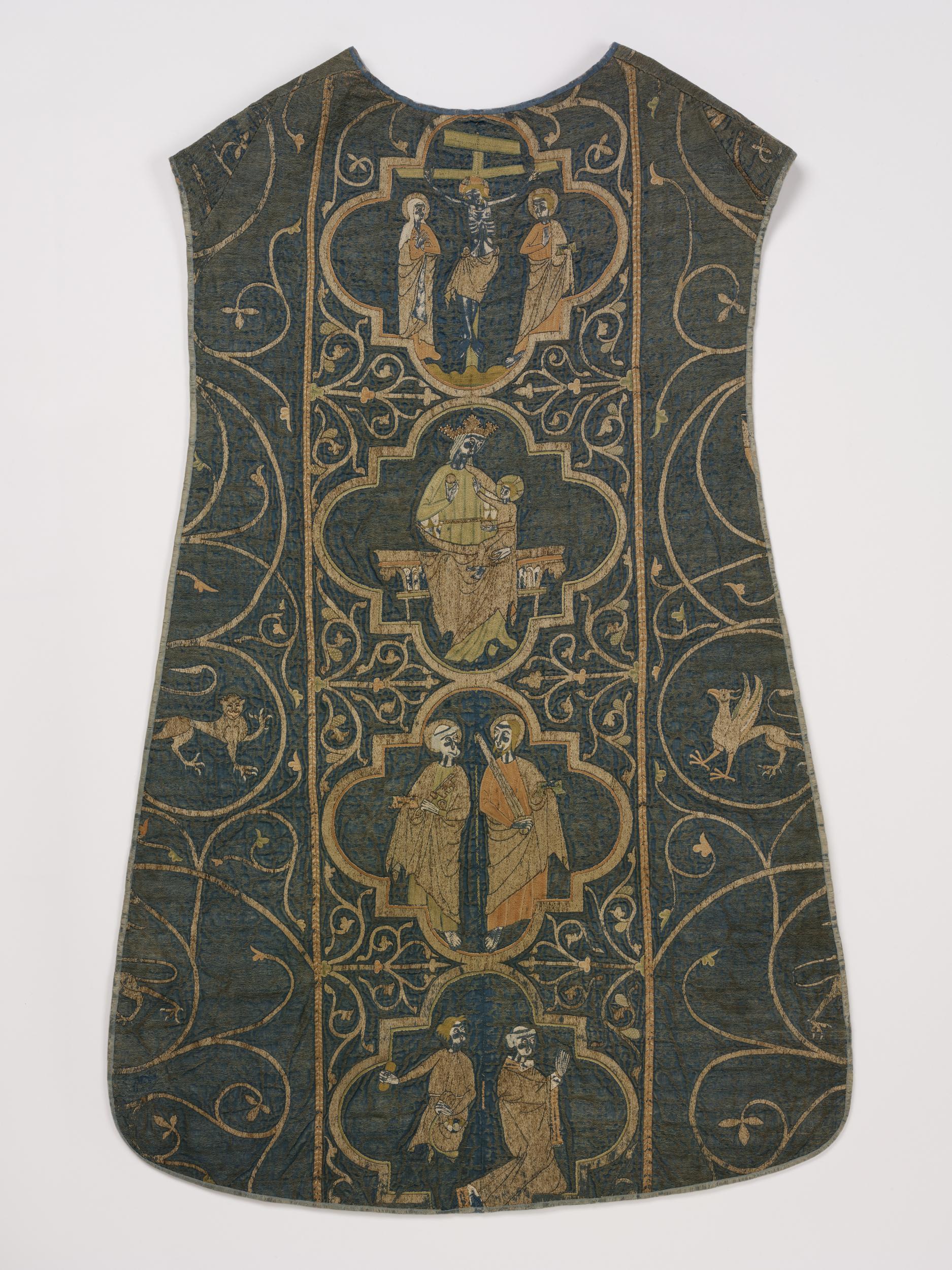
 Cf the amazing Clare Chasuble (below, courtesy of the V&A); you can read more about it here and on this nice post about Opus Anglicanum. It's from about the same time, celebrating the marriage of Margaret de Clare and Edmund, nephew of Henry III. (They were married in 1272 and divorced in 1294.)
(My money's on Bogo de Clare for commissioning the chasuble - Lars Kjaer's exploration of his household accounts show that's exactly the sort of thing he'd go for! By the way, notice the BVM's seat - very like the Merton one.)
On the Oseney seal, Mother and Child sit in a trefoiled arch, with lovely crockets (the things that look like snails crawling up a spire), with buttresses and pinnacles. Birch notes the inscription De Oxonia on the plinth of the niche. They are on top of a platform with two architectural corbels, all being a canopy for an ox passant guardant, for Oxford. The presence of the ox is interesting; Oseney was a major landlord in Oxford, but also had more to do with its university than is generally acknowledged.
The seal has certain similarities with Bruton's, which itself has similarities with Merton's.
Friday, March 13, 2020
Bruton
H. Kingsford pointed out the similarity between Merton's seal and that of Bruton Priory, Somerset.


Left is Bruton's seal and right is Merton's. Merton's, from 1241, has finer workmanship, and it's likely that Bruton's was a copy, or derived inspiration from Merton's. I think that Merton's was the inspiration for a number of seals, including that of Nicholas Farnham, Bishop of Durham. In 1241, Merton was at the height of its powers, being used for royal administration, and being a centre for learning.
The similarities are the Virgin and Child, although she does not hold the virga; the 'windows' with canons' head peeking through; the canopy over the BVM and Child, even with the little rosettes in between the spires. Her throne is different, and it rests on another canopy, under which are canons praying to her. On either side of her, above the panels, are a star and moon. Both the star and moon and the praying figures are fashionable features, and can be seen on various institutional and episcopal seals from the period. No one seems to have made a comprehensive study of these...yet... but I'm working on it! It's impossible to say whether the Bruton seal was from the same workshop, or was a provincial copy. Bruton was nowhere near as wealthy as Merton, and Merton's seal must have cost a lot. I think Kingsford must be right that Merton's seal was made in the workshop that supplied King Henry's seal(s). Could Bruton have afforded a seal by the king's workshop? On the other hand, the Bruton seal is also very fine (I'll try to get a better picture of both seals soon). Perhaps someone was related to someone.
Left is Bruton's seal and right is Merton's. Merton's, from 1241, has finer workmanship, and it's likely that Bruton's was a copy, or derived inspiration from Merton's. I think that Merton's was the inspiration for a number of seals, including that of Nicholas Farnham, Bishop of Durham. In 1241, Merton was at the height of its powers, being used for royal administration, and being a centre for learning.
The similarities are the Virgin and Child, although she does not hold the virga; the 'windows' with canons' head peeking through; the canopy over the BVM and Child, even with the little rosettes in between the spires. Her throne is different, and it rests on another canopy, under which are canons praying to her. On either side of her, above the panels, are a star and moon. Both the star and moon and the praying figures are fashionable features, and can be seen on various institutional and episcopal seals from the period. No one seems to have made a comprehensive study of these...yet... but I'm working on it! It's impossible to say whether the Bruton seal was from the same workshop, or was a provincial copy. Bruton was nowhere near as wealthy as Merton, and Merton's seal must have cost a lot. I think Kingsford must be right that Merton's seal was made in the workshop that supplied King Henry's seal(s). Could Bruton have afforded a seal by the king's workshop? On the other hand, the Bruton seal is also very fine (I'll try to get a better picture of both seals soon). Perhaps someone was related to someone.
Tuesday, February 18, 2020
Walter de Merton's love for Merton Priory sealed...with a seal?
Walter de Merton received his first living from Merton Priory. He was their 'well-beloved clerk' for many years and took his name after the priory, changing it from Walter de Basingstoke. (Just think, it could have been Basingstoke College, Oxford...). J. R. L. Highfield suggested that the Merton College use of 'hostelry, infirmary, and granary seem to reflect the monastic world of Merton Priory' (Early Rolls of Merton [the College!], p.65). Walter's closeness to Merton may perhaps also be seen in his seal.
 In A companion to seals in the Middle Ages (ed. L. J. Whatley, Leiden 2019), Philippa Hoskins writes that the ‘standard form of the English episcopal seal of dignity had emerged’ by the middle of the 12th century (p.201). Bishops were depicted always with their crozier, sinister, and benediction, dexter. ‘From the late twelfth century British bishops begin to be depicted standing on a corbel’ (p.202). Bishops introduce patterns and motifs to distinguish their seals. She suggests that Bishop Richard Marsh of Durham is standing ‘on marshy ground.’ (p.203.) Here he is:
It was a screenshot from this nice site, so to see it better, click on that link!
Richard Marsh (a bit of a villain) was Adam Marsh's uncle. Adam knew our Walter. But back then, it was a small world. Richard's successor-but-a-couple was Nicholas Farnham, physician and philosopher. His seal is below, left. Notice the two windows with heads in them.

 The Merton College historian Roger Highfield put this seal together with that of Nicholas' clerk, Walter of Merton. Here he is, which I managed once to track down online, but can't remember where from. It's in the British Library, anyway. Highfield is right - there is a resemblance. Nicholas Farnham was a Surrey man, not too far from the Hampshire Walter's Basingstoke. Nicholas held the living of Long Ditton from Merton Priory. Walter, in 1233, was given by Merton the living at Cuddington. When Nicholas became Bishop of Durham (1241-9), he took various Surrey types with him, including Walter.
Here's Merton Priory's seal from 1241.
 Look at the heads! BUT before we get too excited, here is a bucket of cold water in the shape of J. P. Dalton's The Archiepiscopal and Deputed Seals of York, 1114-1500 (York, 1992). He says that faces in 'foiled recesses' [now, that needs more investigation - they aren't all foiled - we've noted Nicholas Farnham's lozenges] was quite common in the 13th century: Archbishop Richard Grant of Canterbury (1229-31); Edmund of Abingdon (1233-40) [a good Merton friend - he has 4!], Bishop Robert Stichill of Durham (1261-74). At York, Godfrey Ludham, William Wickwane, John le Romeyne, William Melton. William Greenfield (d.1315) ditched the fussy recesses and just had the heads. Walter's heads are episcopal; Merton's are canonical. Nicholas'? Dunno.
However, there's more to these seals than just the heads. St Augustine, on the Merton seal, stands on a platform supported by a fleur-de-lys (very appropriate for a Marian dedication). So does Walter's. (I can't see whether Nicholas' does.)
 Closer inspection of all of them would yield results; meanwhile, it looks very like the Merton Priory influence spreading everywhere...
Interestingly, Walter's seal doesn't have a canopy; it has a star instead. This star is reminiscent of Jacob the Jew's seal. This is from the Merton College Archives, as is the seal below. They also have Ela Longspee's seal. She's rather an interesting character - definitely a 12th-century blue-stocking, and great friend of both Walter and his college.
 Merton College's 14th-century seal (you can see a beautiful BIG picture of it here) has the BVM and Babe - the college is dedicated to St Mary. It has some Mertonesque features - the ornate canopy, the diapered background (although here just of the seat), and a virga (I think that's what is poking up, sinister), but it's much more like the Oseney's seal: the BVM is handing Christ the orb, and she leans towards him (and that's similar, too, to Merton's first seal). Underneath, there's a strikingly similar arch to Oseney's, but with a tonsured supplicant (Walter?) underneath. Its original seal showed 'five souls held in a cloth in the bosom of Abraham.' That's a really interesting seal!
 In A companion to seals in the Middle Ages (ed. L. J. Whatley, Leiden 2019), Philippa Hoskins writes that the ‘standard form of the English episcopal seal of dignity had emerged’ by the middle of the 12th century (p.201). Bishops were depicted always with their crozier, sinister, and benediction, dexter. ‘From the late twelfth century British bishops begin to be depicted standing on a corbel’ (p.202). Bishops introduce patterns and motifs to distinguish their seals. She suggests that Bishop Richard Marsh of Durham is standing ‘on marshy ground.’ (p.203.) Here he is:
It was a screenshot from this nice site, so to see it better, click on that link!
Richard Marsh (a bit of a villain) was Adam Marsh's uncle. Adam knew our Walter. But back then, it was a small world. Richard's successor-but-a-couple was Nicholas Farnham, physician and philosopher. His seal is below, left. Notice the two windows with heads in them.
 The Merton College historian Roger Highfield put this seal together with that of Nicholas' clerk, Walter of Merton. Here he is, which I managed once to track down online, but can't remember where from. It's in the British Library, anyway. Highfield is right - there is a resemblance. Nicholas Farnham was a Surrey man, not too far from the Hampshire Walter's Basingstoke. Nicholas held the living of Long Ditton from Merton Priory. Walter, in 1233, was given by Merton the living at Cuddington. When Nicholas became Bishop of Durham (1241-9), he took various Surrey types with him, including Walter.
Here's Merton Priory's seal from 1241.

However, there's more to these seals than just the heads. St Augustine, on the Merton seal, stands on a platform supported by a fleur-de-lys (very appropriate for a Marian dedication). So does Walter's. (I can't see whether Nicholas' does.)

Interestingly, Walter's seal doesn't have a canopy; it has a star instead. This star is reminiscent of Jacob the Jew's seal. This is from the Merton College Archives, as is the seal below. They also have Ela Longspee's seal. She's rather an interesting character - definitely a 12th-century blue-stocking, and great friend of both Walter and his college.
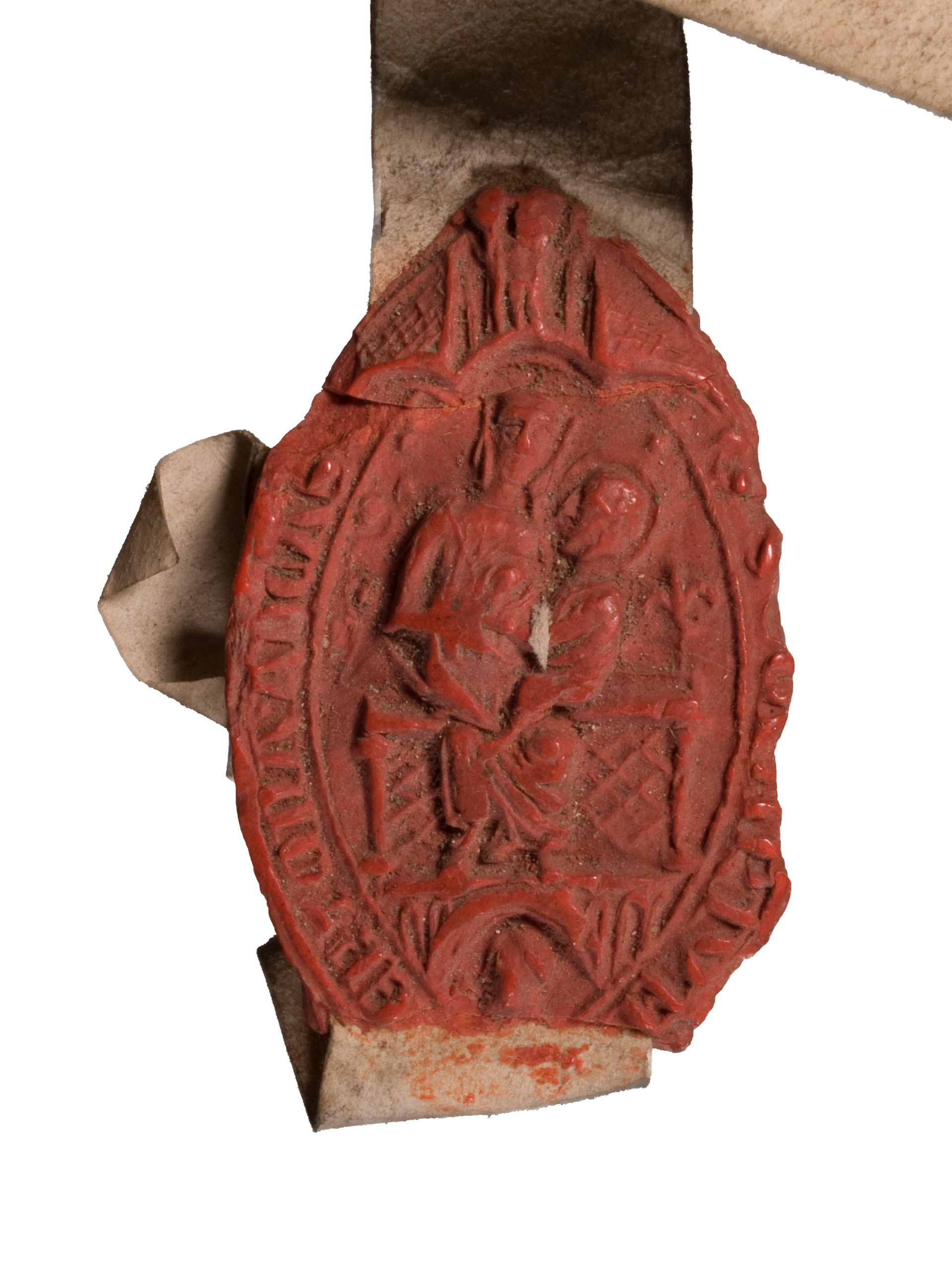 Merton College's 14th-century seal (you can see a beautiful BIG picture of it here) has the BVM and Babe - the college is dedicated to St Mary. It has some Mertonesque features - the ornate canopy, the diapered background (although here just of the seat), and a virga (I think that's what is poking up, sinister), but it's much more like the Oseney's seal: the BVM is handing Christ the orb, and she leans towards him (and that's similar, too, to Merton's first seal). Underneath, there's a strikingly similar arch to Oseney's, but with a tonsured supplicant (Walter?) underneath. Its original seal showed 'five souls held in a cloth in the bosom of Abraham.' That's a really interesting seal!
Subscribe to:
Posts (Atom)