No, she's not an Augustinian canon or canoness. I've just accidentally come across her in Birch.
Agnes, Anchoress of the Church 'de la Hethe', Colchester.
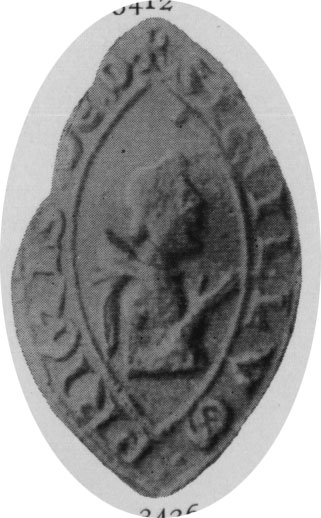
2987 [A.D.1284-5.] Discoloured white: a fragment. About 1 1/8” x 1” when perfect. [Harl. ch. 44 E. 17] Pointed oval: a fleur-de-lis, inverted. Legend reversed: + S’ AGN’T…
This church is St Leonard-at-the-Hythe. (The wonderful Simon Knott has visited it, so there are some nice photos.) VCH says that an anchoress was associated with the church in 1290-1. Clearly, her name was Agnes. (Agnes Dei? Groan.) Anchoresses lived in a cell next a church. They spent all their time in it. There's a nice article on anchoresses here, although it doesn't answer my ever-nagging questions - what did they do about going to the loo (or, rather, clearing it up) and what about washing (mainly that horrid female curse, the period)? The most famous anchoress was another East Anglian, Julian of Norwich, who was about 100 years Agnes' junior. There's a good cell (the vestiges of) at St Anne's Lewes, too.
About Agnes, however, we know nothing. Except that she had a seal. This is most peculiar. Why should an anchoress need a seal? I don't yet know what the seal is sealing, as Birch's reference doesn't seem to tally with the current BL catalogues... Another rabbit-hole to disappear down.......
Thursday, May 21, 2020

Drax
Drax is one of those places hard done by progress. It's been the home of a massive, ugly power station for years. But once upon a time, a much prettier building stood - the Austin priory of Drax. (There's still a handsome, largely Perp, church.) The place name comes from the OE for 'portage', for this is where the Ouse meets the Aire. (These rivers occasionally flooded, to the great detriment of the priory, and everyone else.) The priory's arms show three drakes, so perhaps the origins of the name had been forgotten, or they just liked a good pun.
Drax was one of the many Austin foundations that saw the eminence grise of Archbishop Thurstan, although it was actually William Paynell who founded it.
By the later 12th century, standards at Drax were slipping. It came out badly from Archbishop William Wickwane’s 1280 visitation. The sub-cellarer Elias had been involved in a fight with another canon, and possibly a layman too; canons were keeping property and talking too much and letting far too many layfolk in, etc., and the prior seems to have been quite divisive.
 Presumably this prior (was he Adam?) was replaced by Thomas of Campsall, who used this seal as his secretum (photo: Durham cathedral.) ✠ SIGILLUM : PRIORIS : DE : D. You can get a really good impression (haha) of Augustinian dress from this - the outer cloak, which canons were required to wear inside and outside the cloister (and which was to be black - not blue or white or any other scandalous colour), and the almuce or rochet. Thomas sports a great tonsure, too. You can read about Augustinian dress here (if you can get into JSTOR).
Thomas' successor was Elyas of Burton. Is this the Elyas who lamped a fellow canon? If so, I don't suppose anyone would argue with that father prior...
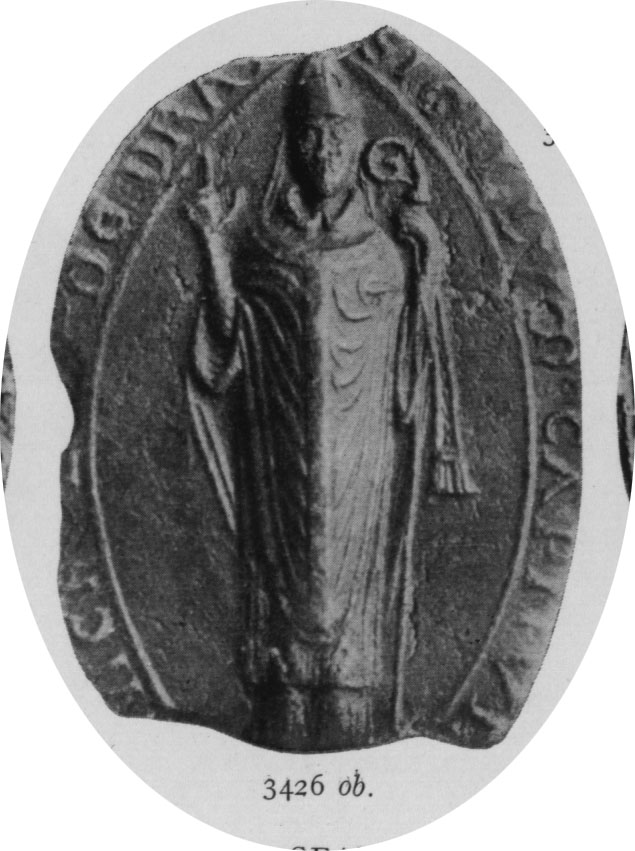
 He's vested for mass, as is usual with episcopal seals. His crozier is a crook turned inwards, and he has a nicely tassled maniple. He also wears a pall. The folds are stylised, and the seal is very different from those of the priory's episcopal superior, the archbishops of York. SIGILLUM CAPITUL[I] [SANCTI] NICH[OLAI] DE DRAX
For another episcopal priory seal, see Merton (which, I have to say, is much lovelier.)
Much later, around 1510, one of its canons was charged, along with several priests and laymen, with trying to obtain treasure by witchcraft; this canon had made a circle and tried to summon the spirit Belphares. Needless to say, the whole enterprise failed miserably and the canon and his 5 cronies were made to walk through the streets of York being ridiculed and whipped.
Drax was dissolved in 1536.
Drax was one of the many Austin foundations that saw the eminence grise of Archbishop Thurstan, although it was actually William Paynell who founded it.
By the later 12th century, standards at Drax were slipping. It came out badly from Archbishop William Wickwane’s 1280 visitation. The sub-cellarer Elias had been involved in a fight with another canon, and possibly a layman too; canons were keeping property and talking too much and letting far too many layfolk in, etc., and the prior seems to have been quite divisive.
Thomas' successor was Elyas of Burton. Is this the Elyas who lamped a fellow canon? If so, I don't suppose anyone would argue with that father prior...
The seal itself shows St Nicholas, the priory's dedicatee.
For another episcopal priory seal, see Merton (which, I have to say, is much lovelier.)
Much later, around 1510, one of its canons was charged, along with several priests and laymen, with trying to obtain treasure by witchcraft; this canon had made a circle and tried to summon the spirit Belphares. Needless to say, the whole enterprise failed miserably and the canon and his 5 cronies were made to walk through the streets of York being ridiculed and whipped.
Drax was dissolved in 1536.
Monday, May 11, 2020
St Andrews
 If Guisborough's seal perhaps depicted its actual church buildings, there's little doubt that St Andrews' seal really does. (Ah. St Andrews Cathedral. I used to revise for medieval history exams in its cloister, although its sunny tranquillity was a little too soporific to recommend it as a place for work.)
But this central tower to me looks like St Reg's Tower (it seems officially to be St Rule's Tower - but St Rule's Tower is a bit of a mouthful, so everyone used, at any rate, to call it Reg's). And lo, so it says, here (with a nice bit of audio from Richard Fawcett). You can see traces of the roof-lines of the east and west bits (this Wikipedia/ Geograph photo shows several roof-lines), and the west end is very like what's left of the east and west ends of the St Andrews Cathedral building next door (there's a bit of an optical illusion going on in this photo!). I wish they'd put the spire back on St Reg's - especially if it really was that rather nice snail-shell spiral in the seal!

‘issuing from the upper part is a dexter hand, the forefingers pointing upwards. At the lower part of the seal is an ornament composed of three semicircles interlaced.’ (It's not this one, but I like the idea of fingers of right reason pointing upwards. St Andrews was where I first encountered the finger of right reason.)
‘in addition to the saltire and the hand, there is in this a crescent and an estoile, and on the sinister side of the tower is a cross in the place of the saltire’ (That's more like it - the second seal, or, at least, a later one than the above.
Here's a rather nice reconstruction of St Andrews. The history of St Andrews is very interesting, but too long for here. It's an example of an Augustinian house taking over a much older one, in this instance a Culdee house.

The counterseal is St Andrew himself. This slender figure is a little disturbing! It looks late 12th-century. The inscription is SECRETUM C[ON]VEN' S ANDREE.
The thumb or finger prints are magnificent. (There's a fingerprint project on seals here.)
(In 2016, a teenage detectorist dug up the seal of William Lamberton, bishop of St Andrews (1297-1338).)
Photos of the seals are from Durham University Library.
-------------------------------------
I didn't particularly enjoy my student days at St Andrews, although it
was a beautiful place to be in, and there were some very good tutors. But I did make some very good friends,
and it's rather nice that the bottom of the seal should have such a
topological design - my best friend from St Andrews is now one of the leading topologists in the world.
Tuesday, May 5, 2020
St Osyth's
St Osyth's Priory (or Abbey, as it soon became), Chich, Essex, is absolutely gorgeous. You can see it here. The Austin priory was founded by Richard Belmeis, Bishop of London, c.1121, and its first prior was William de Corbeil, who became Archbishop of Canterbury.
Osyth was the daughter of Anglo-Saxon aristocrats, who, with St. Erconwald, founded Chertsey Abbey (675). Being the daughter of A-S aristocrats, she wasn’t allowed to become the nun that she wanted to be, but was forced into marriage. When her husband, King Sighere of Essex, was out hunting, she nipped down to the local bishops and got them to nun her. Sighere, being a decent chap, gave her some land at Chich, and she founded a convent there.
Osyth died twice. The first time happened when she was a girl. Her aunt, St. Edith of Aylesbury, sent her to deliver a book to St. Modwenna of Northumbria at her convent. Bt the convent lay the other side of a stream (presumably a pretty big stream). It was swollen, and she drowned. No-one missed her - Aunt Edith thought she must with Modwenna; the book was a surprise gift, so Modwenna knew nothing about it or its bearer. When Osyth still hadn’t come back the next day, Edith went looking for her - picking up Modwenna on the way. They found her wet corpse by the stream, and prayed. Osyth got up.
Later, once she had set up her convent and enjoyed being abbess for a while, some nasty pirates raided the convent and chopped off her head. BUT… she picked up her head and walked to the convent door, before collapsing. (The story gets transferred to Quarrendon in Bucks, where she was born, so it’s all a bit confused.) Anyway, this makes her a ‘cephalophore’ - that’s a new word on me (thanks, Wikipedia!), but it’s easy to dissect - ‘cephale’ is Greek for ‘head’, and ‘phore’ is carrier (from ‘pherein’, to carry).

There are two seals catalogued by de Gray Birch. The first is from 1285, and the second from the 15th century. Both have similar subject matter, viz. Osyth. (The 15th-century one has, in addition, an angel holding a shield of the 3 crowns of East Anglia.)
This seal is the 13th-century one. Under a fine canopy, with lovely slender columns, and the sword and key of Paul and Peter, is Osyth with her head. Glorious.
S' • ECCE • SCE : OSYTHE • DE : CHIC : AD • CAS •
Its counterseal is, in the field, left, a cross;
Christ nimbed, lifting up right hand in benediction.
Osyth was the daughter of Anglo-Saxon aristocrats, who, with St. Erconwald, founded Chertsey Abbey (675). Being the daughter of A-S aristocrats, she wasn’t allowed to become the nun that she wanted to be, but was forced into marriage. When her husband, King Sighere of Essex, was out hunting, she nipped down to the local bishops and got them to nun her. Sighere, being a decent chap, gave her some land at Chich, and she founded a convent there.
Osyth died twice. The first time happened when she was a girl. Her aunt, St. Edith of Aylesbury, sent her to deliver a book to St. Modwenna of Northumbria at her convent. Bt the convent lay the other side of a stream (presumably a pretty big stream). It was swollen, and she drowned. No-one missed her - Aunt Edith thought she must with Modwenna; the book was a surprise gift, so Modwenna knew nothing about it or its bearer. When Osyth still hadn’t come back the next day, Edith went looking for her - picking up Modwenna on the way. They found her wet corpse by the stream, and prayed. Osyth got up.
Later, once she had set up her convent and enjoyed being abbess for a while, some nasty pirates raided the convent and chopped off her head. BUT… she picked up her head and walked to the convent door, before collapsing. (The story gets transferred to Quarrendon in Bucks, where she was born, so it’s all a bit confused.) Anyway, this makes her a ‘cephalophore’ - that’s a new word on me (thanks, Wikipedia!), but it’s easy to dissect - ‘cephale’ is Greek for ‘head’, and ‘phore’ is carrier (from ‘pherein’, to carry).

There are two seals catalogued by de Gray Birch. The first is from 1285, and the second from the 15th century. Both have similar subject matter, viz. Osyth. (The 15th-century one has, in addition, an angel holding a shield of the 3 crowns of East Anglia.)
This seal is the 13th-century one. Under a fine canopy, with lovely slender columns, and the sword and key of Paul and Peter, is Osyth with her head. Glorious.
S' • ECCE • SCE : OSYTHE • DE : CHIC : AD • CAS •
Its counterseal is, in the field, left, a cross;
Christ nimbed, lifting up right hand in benediction.
Wednesday, April 29, 2020
Ravenstone
There's nothing left of Ravenstone Priory - and not even an entire seal, either. I don't yet have a picture of it. The BM copy dates from the priorate of Ralph (second or third prior, 1275-1309), as his seal is the counterseal. Ravenstone's seal is a pointed oval with the BVM seated on a carved throne. Ralph's seal also has the BVM, but half-length, under a trefoiled arch, the Child on her left knee. If these sound familiar, it's not so much that Ravenstone Priory was dedicated to the BVM (like most Austin priories), but because there is some connexion with Merton Priory, of which more below. Back to the obverse. Underneath the BVM is a trefoiled arch with carved spandrils, and
central pillar; on the left a woman kneels and holds up what Birch describes as 'an indistinct
object'. The right-hand figure is missing. The inscription is . . . G • D RAVENES. Ralph's seal has him kneeling in prayer, in base, under a quadrilobe with arched spandrils. RADVLPHI • PRIORIS D RAVE ...
The Priory was founded by Peter Chaceporc, keeper of the royal wardrobe. He's one of those really rather important chaps of whom not terribly much is known (see, as usual, the Oxford DNB). The VCH says Ravenstone was founded 'about1255' by him, and 'after the death of Peter the patronage of the house reverted to the Crown, and the canons were bound to sing a certain number of masses for the soul of the king as founder.' But elsewhere the VCH says that the canons celebrated the souls of Peter and his uncle Hugh de Vivon, so it's a bit confusing. The charter, quoted in Dugdale, says that Hugh Chaceporc, Peter's big brother and executor, bought the necessary land off Saher de Wahull; Henry confirmed the land and co-founded the priory.
Ravenstone was never rich, but it had enough money to support some canons to be, essentially, a chantry. It owned half a knight's fee and the parish church. At its dissolution, in 1524, it had only two canons; it is doubtful whether even at its height there were many more than a handful.
Peter shared the manor of Ravenstone with the Crown, having rented his half off Saher de Wahull for - delightfully - a pair of gilt spurs. Part of the priory land is now two rows of almshouses, built in the 17th century.
Now, the Merton connexion. Matthew Paris says:
'On the third day before the Nativity [1255], the same Peter made his will. And amongst other things, he left 600 marks for to provide land, in England, where lands were more able and ready to be bought, and there to have built a monastic church, viz. of canons regular, coming from the house of Merton, and there God would be served with grace and honour, and sacrifice offered everyday to God for his soul and the souls of all the faithful.’
Ravenstone was this priory. Dugdale gives the first prior as 'William de Divisis' (Devizes), but the VCH gives the first prior as Adam of Wymondley (resigned 1275). Wymondley is between Stevenage and Letchworth, so not too far from Ravenstone. Merton held lands around there, for example in Kimpton. Merton held lands near Chippenham, which isn't that far from Devizes, but it's not especially near. Merton did have a canon called Roger of Deveneis (Devonish) in 1239. There are no records of either Adam or William at Merton, but we don't know even nearly half the brethren there! We also don't know for sure that Merton supplied the first canons of Ravenstone, but there's no reason to think not: that was Peter's wish, and Merton had supplied plenty of priories in the previous century - and Henry III was involved (he seems to have been a co-founder), and Merton was heavily involved with Henry. Indeed, Peter's colleague in government, John Mansel, also founded an Augustinian priory, at Bilsington, with Merton canons. John was one of the witnesses to the charter of Ravenstone.
The Priory was founded by Peter Chaceporc, keeper of the royal wardrobe. He's one of those really rather important chaps of whom not terribly much is known (see, as usual, the Oxford DNB). The VCH says Ravenstone was founded 'about1255' by him, and 'after the death of Peter the patronage of the house reverted to the Crown, and the canons were bound to sing a certain number of masses for the soul of the king as founder.' But elsewhere the VCH says that the canons celebrated the souls of Peter and his uncle Hugh de Vivon, so it's a bit confusing. The charter, quoted in Dugdale, says that Hugh Chaceporc, Peter's big brother and executor, bought the necessary land off Saher de Wahull; Henry confirmed the land and co-founded the priory.
Ravenstone was never rich, but it had enough money to support some canons to be, essentially, a chantry. It owned half a knight's fee and the parish church. At its dissolution, in 1524, it had only two canons; it is doubtful whether even at its height there were many more than a handful.
Peter shared the manor of Ravenstone with the Crown, having rented his half off Saher de Wahull for - delightfully - a pair of gilt spurs. Part of the priory land is now two rows of almshouses, built in the 17th century.
Now, the Merton connexion. Matthew Paris says:
'On the third day before the Nativity [1255], the same Peter made his will. And amongst other things, he left 600 marks for to provide land, in England, where lands were more able and ready to be bought, and there to have built a monastic church, viz. of canons regular, coming from the house of Merton, and there God would be served with grace and honour, and sacrifice offered everyday to God for his soul and the souls of all the faithful.’
Ravenstone was this priory. Dugdale gives the first prior as 'William de Divisis' (Devizes), but the VCH gives the first prior as Adam of Wymondley (resigned 1275). Wymondley is between Stevenage and Letchworth, so not too far from Ravenstone. Merton held lands around there, for example in Kimpton. Merton held lands near Chippenham, which isn't that far from Devizes, but it's not especially near. Merton did have a canon called Roger of Deveneis (Devonish) in 1239. There are no records of either Adam or William at Merton, but we don't know even nearly half the brethren there! We also don't know for sure that Merton supplied the first canons of Ravenstone, but there's no reason to think not: that was Peter's wish, and Merton had supplied plenty of priories in the previous century - and Henry III was involved (he seems to have been a co-founder), and Merton was heavily involved with Henry. Indeed, Peter's colleague in government, John Mansel, also founded an Augustinian priory, at Bilsington, with Merton canons. John was one of the witnesses to the charter of Ravenstone.
Friday, April 3, 2020
Bilsington
The reason for this post is not so much the seal as just sorting out a few Merton-related things.
Bilsington Priory was founded in 1253 by John Mansel. In 1261, Merton Priory confirmed that it had no jurisdiction over the house or its priors, despite the first three priors having come, at Mansel's request, from Merton (Heales, p.137-8). This third prior was R. de South Malling. The first prior was William. The VCH records, from the Close Rolls of Edward III, one Walter as the second prior (c.1255), and we can add R. de South Malling (c.1261 probably till 1276). In 1276, Merton's links with Bilsington's priors seem to have ended, as John Romenale was, according to VCH, a canon of Leeds Priory.
I don't have a picture of the seal, but it sounds a nice one. It's from the 14th century, and is a pointed oval. W. de Gray Birch describes it thus: "in an elegantly carved niche with three trefoiled canopies, pinnacled and crocketed, the coronation of the Virgin, an angel issuing from above and placing the crown on her head. Background diapered. In base, under an arcaded corbel, the founder, John Mansell, Provost of Beverley, turned to the r. h., holding a model of the Church ; and a group of kneeling canons. SIGILLVM • COMMVNE • ECCLESIE • SANCTE • MARIE • DE • BILSINGTONE."
The Coronation of the Virgin can be seen on Anthony Bek's seal, which will have to do for you until I get to snap this one. She's being crowned on the counterseal (the reverse); Bek himself is enthroned on the obverse, between SS Oswald and Cuthbert.

(By the way, I see there's an Anthony Bek Nursery and Primary School. What do they teach them? Profligacy? Hypocrisy? War-mongering?! By the way, too, I nicked these photos from the Age of Chivalry book, which is no longer in print, being a catalogue from an exhibition in the '80s, but which is really rather nice and defo worth having on your book shelf or coffee table if you can find a copy.)
Like Combwell, Bilsington is now a wedding venue. They seem to call it St Augustine's, but it was actually St Mary's - perhaps they're confusing it with being an Augustinian priory?
I'm just going to dump the list of witnesses to the foundation here, in case I need them later.
Bilsington, witnessed by Boniface, William, Bishop of Salisbury, Peter d’Aigueblanche (Hereford), Richard of Gloucester, Peter of Savoy, Peter Chaceporc, AD of Wells, Mr Wm Kilkenny, AD Coventry, Ralph Fitz Nicholas, John Grey, Bertam Cricel, John de Lexington, Robert Walerand, William de Lichfield, canon of London, Mr John Clarel, Geoffrey de Childerwick, Richard de Tilbury, Alard Fleming, Thomas de Colchester, Simon de Huntingdon, chaplain, and many others. 1253, June.
Bilsington Priory was founded in 1253 by John Mansel. In 1261, Merton Priory confirmed that it had no jurisdiction over the house or its priors, despite the first three priors having come, at Mansel's request, from Merton (Heales, p.137-8). This third prior was R. de South Malling. The first prior was William. The VCH records, from the Close Rolls of Edward III, one Walter as the second prior (c.1255), and we can add R. de South Malling (c.1261 probably till 1276). In 1276, Merton's links with Bilsington's priors seem to have ended, as John Romenale was, according to VCH, a canon of Leeds Priory.
I don't have a picture of the seal, but it sounds a nice one. It's from the 14th century, and is a pointed oval. W. de Gray Birch describes it thus: "in an elegantly carved niche with three trefoiled canopies, pinnacled and crocketed, the coronation of the Virgin, an angel issuing from above and placing the crown on her head. Background diapered. In base, under an arcaded corbel, the founder, John Mansell, Provost of Beverley, turned to the r. h., holding a model of the Church ; and a group of kneeling canons. SIGILLVM • COMMVNE • ECCLESIE • SANCTE • MARIE • DE • BILSINGTONE."
The Coronation of the Virgin can be seen on Anthony Bek's seal, which will have to do for you until I get to snap this one. She's being crowned on the counterseal (the reverse); Bek himself is enthroned on the obverse, between SS Oswald and Cuthbert.

(By the way, I see there's an Anthony Bek Nursery and Primary School. What do they teach them? Profligacy? Hypocrisy? War-mongering?! By the way, too, I nicked these photos from the Age of Chivalry book, which is no longer in print, being a catalogue from an exhibition in the '80s, but which is really rather nice and defo worth having on your book shelf or coffee table if you can find a copy.)
Like Combwell, Bilsington is now a wedding venue. They seem to call it St Augustine's, but it was actually St Mary's - perhaps they're confusing it with being an Augustinian priory?
I'm just going to dump the list of witnesses to the foundation here, in case I need them later.
Bilsington, witnessed by Boniface, William, Bishop of Salisbury, Peter d’Aigueblanche (Hereford), Richard of Gloucester, Peter of Savoy, Peter Chaceporc, AD of Wells, Mr Wm Kilkenny, AD Coventry, Ralph Fitz Nicholas, John Grey, Bertam Cricel, John de Lexington, Robert Walerand, William de Lichfield, canon of London, Mr John Clarel, Geoffrey de Childerwick, Richard de Tilbury, Alard Fleming, Thomas de Colchester, Simon de Huntingdon, chaplain, and many others. 1253, June.
Thursday, April 2, 2020
Combwell
This is a special seal. The Priory was dedicated to Mary Magdalene, and despite its being reduced from abbatial status to a priory in the early 13th century because it wasn't rich enough, it still managed to afford this seal!

Mary M was conflated in the early Middle Ages with the person whom Christ drove devils out of, and with a prostitute whom he befriended. She became the sinner's sinner, and was hugely popular in the 12th and 13th centuries, partly because of a fashion for confession and weeping: she had sinned; she wept at Christ's passion, and her tears showed her true repentance. We can take comfort from her and be like her. In this seal, MM washes Christ's feet as he, sitting between two disciples (are they Peter and John?), partakes of his Last Supper. (Yes, that's 'partakes' used correctly...!) She's, of course, under the table, but so are the two demons whom Christ has driven out of her - they are making a hasty exit.
This photo is too small to see, but Elizabeth New says that 'a band across the table inserts maria before the scriptural fides tva (te salvam fecit) (“Your faith has saved you”). (Luke 7:50).' Noteworthy also is the building in which Christ and his disciples dine. This represents the building on Mount Sion whose cenaculum, or refectory (dining room), hosted the Last Supper. The cenaculum was important for the Augustinians, as Peter Fergusson pointed out: their raison être was the Apostolic life, and as a result in the 12th century, many priories consciously imitated the cenaculum in their refectory buildings. We don't know what Combwell's refectory was like, as nothing of it exists any more, but it's interesting that the canons chose the cenaculum to have on their seal.
The building fits into a tradition of church buildings on seals, which you can see discussed here. The trefoiled arch is very much of the period, and appears on lots of episcopal seals, for example. The trefoils and roundel above recall the west front of Wells, built around the time. (We don't quite know when this seal is from - it says 1133 on the back, but that must be a mistake, because this is a later style; it may be 1233, but could be c.1213.) The towers, on the other hand, look more like Rochester's, of an earlier generation. The moon (and is that a sun above it?) and star are frequent motifs on contemporary seals.

The counterseal, or reverse, is a Noli me Tangere scene (John 20:14-18). Mary is the first to see Christ, but he asks her not to touch him, as he hasn't properly risen yet.
Mary's figure in both scenes is reminiscent of the praying figures commonly found in the base of seals, and she represents us, abasing ourselves and praying to Christ.
This is an intriguing seal in many respects, and deserves a more detailed study.
Combwell is now a farm and wedding venue.
Mary M was conflated in the early Middle Ages with the person whom Christ drove devils out of, and with a prostitute whom he befriended. She became the sinner's sinner, and was hugely popular in the 12th and 13th centuries, partly because of a fashion for confession and weeping: she had sinned; she wept at Christ's passion, and her tears showed her true repentance. We can take comfort from her and be like her. In this seal, MM washes Christ's feet as he, sitting between two disciples (are they Peter and John?), partakes of his Last Supper. (Yes, that's 'partakes' used correctly...!) She's, of course, under the table, but so are the two demons whom Christ has driven out of her - they are making a hasty exit.
This photo is too small to see, but Elizabeth New says that 'a band across the table inserts maria before the scriptural fides tva (te salvam fecit) (“Your faith has saved you”). (Luke 7:50).' Noteworthy also is the building in which Christ and his disciples dine. This represents the building on Mount Sion whose cenaculum, or refectory (dining room), hosted the Last Supper. The cenaculum was important for the Augustinians, as Peter Fergusson pointed out: their raison être was the Apostolic life, and as a result in the 12th century, many priories consciously imitated the cenaculum in their refectory buildings. We don't know what Combwell's refectory was like, as nothing of it exists any more, but it's interesting that the canons chose the cenaculum to have on their seal.
The building fits into a tradition of church buildings on seals, which you can see discussed here. The trefoiled arch is very much of the period, and appears on lots of episcopal seals, for example. The trefoils and roundel above recall the west front of Wells, built around the time. (We don't quite know when this seal is from - it says 1133 on the back, but that must be a mistake, because this is a later style; it may be 1233, but could be c.1213.) The towers, on the other hand, look more like Rochester's, of an earlier generation. The moon (and is that a sun above it?) and star are frequent motifs on contemporary seals.
The counterseal, or reverse, is a Noli me Tangere scene (John 20:14-18). Mary is the first to see Christ, but he asks her not to touch him, as he hasn't properly risen yet.
Mary's figure in both scenes is reminiscent of the praying figures commonly found in the base of seals, and she represents us, abasing ourselves and praying to Christ.
This is an intriguing seal in many respects, and deserves a more detailed study.
Combwell is now a farm and wedding venue.
Subscribe to:
Posts (Atom)