Search This Blog

Wednesday, January 1, 2025

Dodnash Priory?

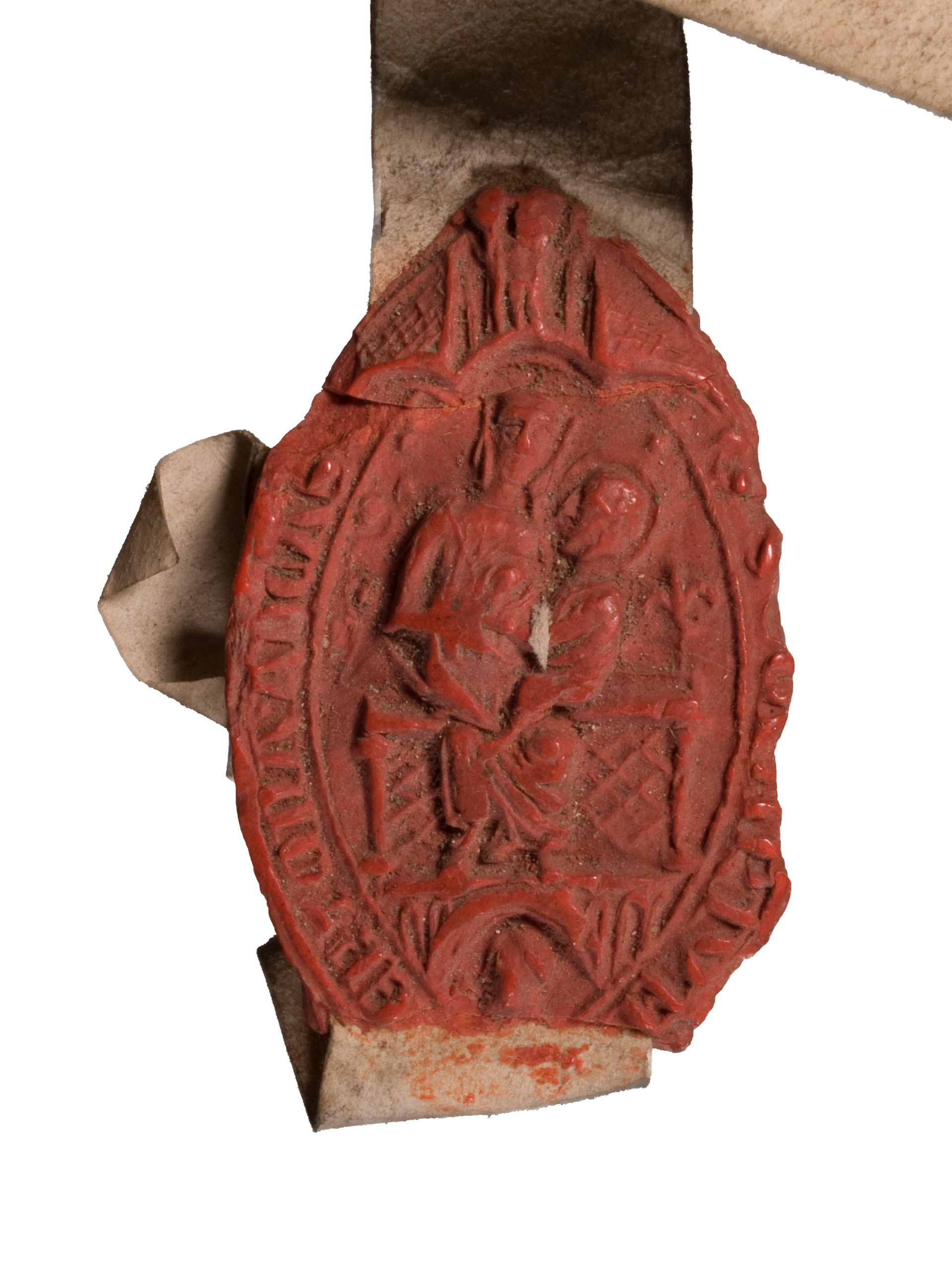
 On the admirable PAS site is this seal. 


It is probably late thirteenth century, and reads

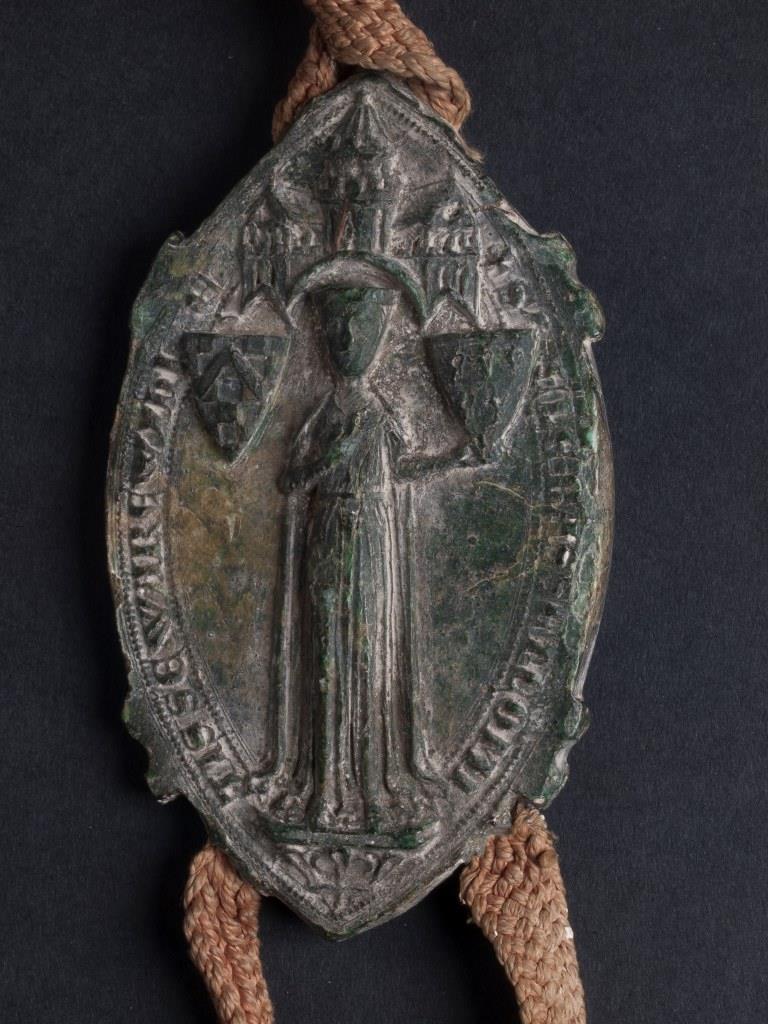
*S.MARIE.DE:SAUMFORD

The PAS identifies this as Samford, Suffolk and suggests that it was from Dodnash Priory. It has the common iconography of the BVM and Babe under a trefoiled arch, with two pinnacles either side, and a suppliant underneath.

Dodnash seems to have been founded by a Wimer, chaplain of Henry II, on lands belonging to the Tosny family. It held lands locally in Bentley, Chelmondiston and Bergholt. A tiny house, it was worth £44 18s 8½d in 1525, when (consequently) it was suppressed by Cardinal Wolsey, so that he could use it in his foundation project in Ipswich.

There's a photo of the scant remains on the East Bergholt Society website.

Thursday, March 24, 2022

Butley Priory

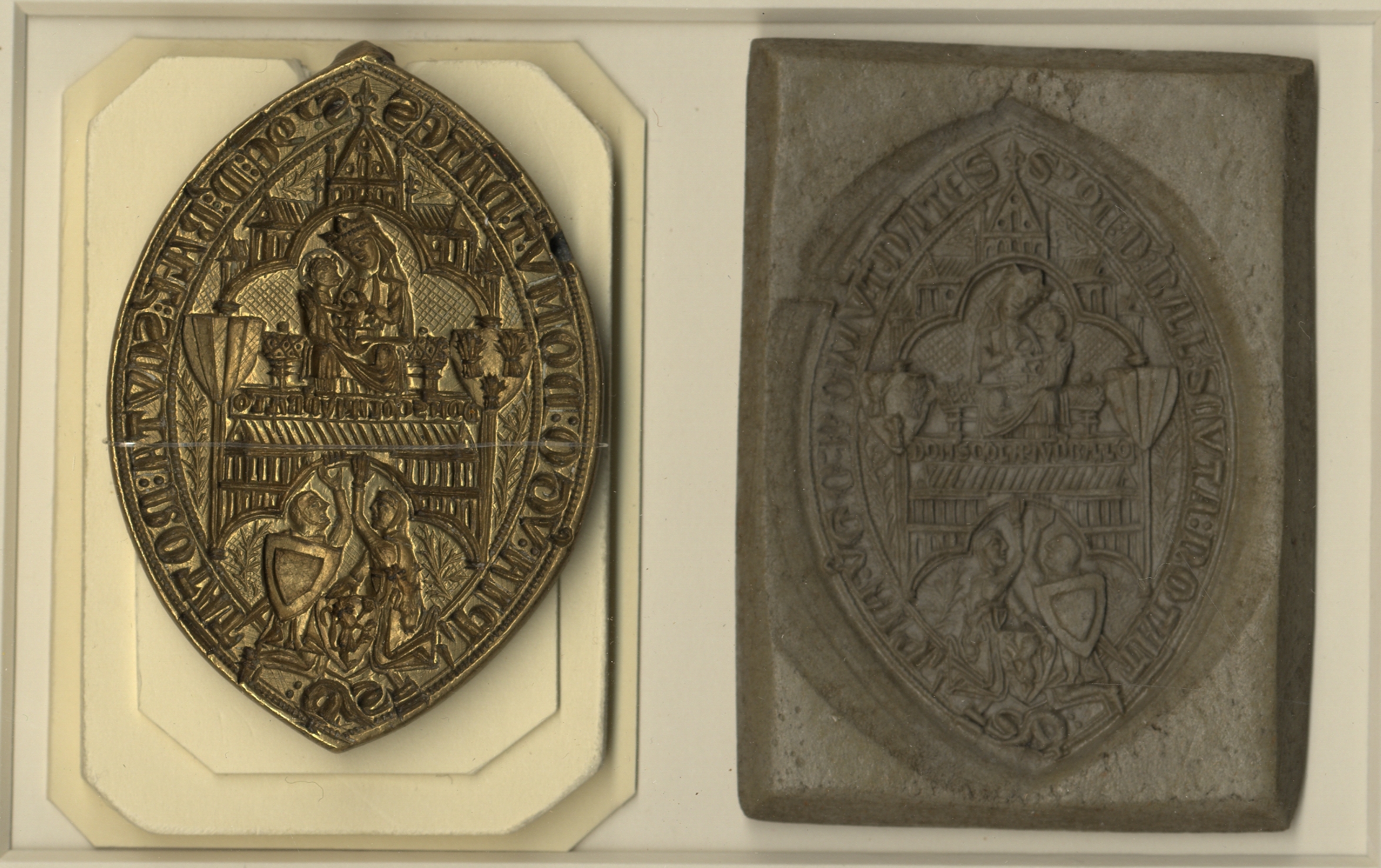
Earlier this year (2022), a young boy called George was out with his metal detector in a field near Butley Priory and found this seal. He was 'tagging along' with his dad, who'd been detecting for 20 years. No doubt his dad had that special mixture of pride and envy!

Not much is left of Butley Priory, but what is left (the gatehouse*) is stonking. I'll complete this post when I've found my 20-year-old notes on the complete heraldry of the gatehouse (I hope I didn't chuck them away), but for now here are some pictures of it I took the other day, showing front and back.

* There are a few more ruins, actually, as you'll see from the excellent Wikipedia article.

The seal predates the gatehouse by a few years - the gatehouse being c.1300 and the seal, from the , mid-13th century, although it might be mid-to-late. You can find a full description of it on the wonderful finds.org, where these images are from. (finds.org will eat your day. Be warned.)

Left is the matrix; right an impression. The BVM, crowned and enthroned, with the Babe, nimbed, on her lap; she holds the orb, which he pats. Finds.org describes the orb as a sceptre, but it looks to me like an orb such as on Oseney's seal.

On her right, what looks like a fleur-de-lis virga (finds.org describes it as a f-d-l and its opposite as a lily, but ?). Above, a trefoiled canopy with two columns, atop which, a cross (and some sort of roof?). The cross cunningly becomes the start/end separator for the legend. In base, two trefoils either side of a trefoiled arch with a canon praying.  There are pellets in four places, chief and base, marking or representing something.

The legend is a bit hard to read. The first bit is easy:  S’PRIORIS ET CONVENT’ DE BVTTEL. But then... Finds.org gives it as O[or D]E AD CR [or A], with a possible interpretation of ‘canonico regulare’ (CR). But I think that's problematic - I've seen this nowhere else, and I'm not convinced that an Austin priory would describe itself thus. I find their second interpretation more convincing - that it's DE AD, being 'de Adae', of Adam the prior (who could be the figure at the bottom - that's not unusual). There was a Prior Adam - he was in office from c.1219 to 1235/6, when he was perhaps the prior of Butley sacked by Archbishop Edmund of Abingdon. That still leaves two letters - CA or CR to deal with - the 'canons of Augustine' or 'canons regular'. I'll need to do some research here, as I just cannot be convinced by this. 

The later, 14th-century, seal, described by Birch, is no help:

816. Pointed oval: BVM, crowned, seated on a throne, with Babe, nimbed, on left knee; r. h. a fleur-de-lize sceptre, with birds billing in the foliage at the top, in an elaborately carved niche with buttresses at the sides, and canopy pinnacled and crocketed. In the field outside the niche, on each side a palm branch. In base under a carved arch with a window of tracery on each side, the Prior kneeling in prayer to the left. Legend: :S’.9E’.ECCE’.SC[E’.M]ARIE DE [:BV]TTELE

This seal is a great find. Sadly, it's up for auction, and not being given to a museum, but people need money...

Talking of which, if you have a few thousand to spare, you can hire Butley's gatehouse.

Thursday, February 17, 2022

Haltemprice

This seal is from the 14th century, and so we're now firmly in the heraldic age, as it demonstrates rather nicely.

Haltemprice was a late foundation. In late 1320, Thomas Wake, lord of Liddell, received permission from the pope to found an Austin priory in Cottingham. Failing to find a suitably long-term site, Thomas got the king’s permission in 1322 and the pope’s in 1325 to move his monastery (which by now had some canons from Bourne) to Newton (which was also known as Haltemprice), a couple of miles down the road. The priory was dedicated to the Holy Cross, the BVM and SS. Peter and Paul, and its first prior, Thomas de Overton, was elected in 1327. Wake bequeathed various lands and properties; in 1361 John de Meaux granted the manor of Willerby for a yearly mixed rent of money and requiems. The priory was always small: in 1328, it seems to have had four brethren, including the prior; in 1424 it had 11; at its dissolution in 1536, it had nine. By then, there were also forty servants and boys – we must remember that a monastery wasn’t just its monks, nuns or canons.

Haltemprice was not rich, and any financial mismanagement had grave consequences. In 1367, Archbishop Thoresby of York intervened to get the priory out of its massive debts. In 1400, the pope granted it an indulgence for almsgivers, and an indult for the prior to hear confessions (and, delightfully, in 1402, an indult for the prior and canons to wear shoes rather than their Austin sandals). Disaster struck Haltemprice sometime around then – the bell-tower collapsed during a storm, taking with it much of the church and cloister, and fire destroyed the priory gate and surrounding buildings. To help monastic finances, the pope regranted the indulgence for ten years.

As a local shrine, it boasted an arm of St. George, a piece of the Holy Cross, and a piece of the BVM’s girdle (for women in childbirth). People also prayed to Thomas Wake for fever.

It's now a derelict farmhouse.

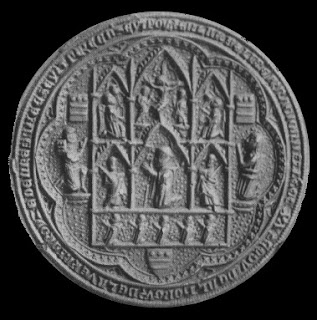
Its seal is splendid. 2¾ inches in diameter, the seal obverse shows a building (presumably the priory church) flying two banners with Thomas Wake's arms on (two bars, three roundels in chief). The three shields are: right (sinister), Wake; left (dexter) ?Stuteville; in base, a cross paty (the Holy Cross?).

On the obverse, (fn. 68) inclosed in an octofoil, having fleurs de lis and leopards' heads alternately in the spandrels, is a representation of the house, with two banners on, its roof of the arms of Thomas, Lord Wake of Liddell, the founder. On the right is a shield of his arms, two bars with three roundels in the chief, and on the left is a burelly shield which perhaps represents the arms of the Stutevilles of Liddell, whose heiress was great-grandmother of the founder. Below is a third shield charged with a cross paty. The design is contained within an octofoil which has, alternately, fleurs-de-lys and leopards' head in the spandrels.

The legend is ✠ CEO EST LE SEAL LABBE E LE COVENT DE COTINGHAM QVE NOVS THOMAS WAKE SINGNOVB DE LIDEL AVOMES FOVNDE.

The counterseal has another octofoil, with trefoils in the spandrels. Two more Wake banners flutter, this time from a big screen, which has the Holy Cross in the top middle (with Christ, Mary and John), and either side two canon thurifers praying. Below is the prior, kneeling in prayer, between St. Peter and St. Paul, and below them are five praying canons. Outside this screen are the two founders - dexter, Thomas, Lord Wake (with armorial ailettes); sinister, his wife. The Wake arms are in base. The legend continues that of the obverse:

✠ EN L'AN DE L'INCARNACION MILL' CCCXXX SECOVNDE AL HONOVR DE LA VERAI CROYZ E DE N[otr]E DAME E SEYNT PERE E D' SE[yn]T POVL.


Monday, January 10, 2022

Chichester's seal

A slight departure here, but one which helps us think about the iconography of seals. An interesting article by Lloyd de Beer (hereafter LdB) on Chichester Cathedral seal is here.  I'll summarise it, as it's not written very concisely.

The second seal of Chichester is interesting because on the obverse it has a church, landscape on an oval seal (highly unusual, if not unique), and the church is labelled 'templum iusticie' (temple of justice).  The inscription reads SIGILLUM SANCTE CICESTRENSIS ECCLESIE - seal of the holy Chichester church.  LdB makes much of this, saying that you'd expect 'the chapter of the cathedral' on the inscription - and, for sure, lots of cathedral seals have that (the everyday ad causas Chichester seal, for one).  But Norwich, for example, doesn't.  LdB makes much of it because he uses it as a brick to build up his thesis that Ralph Neville, the bishop of Chichester, commissioned the seal. But I think we have to discard it - although that doesn't make his thesis any less sturdy.

The counterseal (making the reverse of the imprinted bit of wax) is Christ nimbed (with a halo), under a gothic canopy, enthroned on a church, holding (l-h) a book or tablets and blessing with his r-h.  The inscription is EGO SUM VIA VERITAS ET VITA (I am the way, the truth and the life).  LdB links this to Christ described in Revelation (he says 4:1, but I think he means 4:3), and also to Ezekial 43:6-7.  Nice.  After a bit of over-egged flannel, and ideas about the obverse, LdB compares this to Ralph Neville's own seal, and you only have to look at them to see that they are related.


So, back to the obverse seal.  (Image :  British Museum.)  LdB makes a good point about Christ being the temple, and compares it to the Canterbury second seal.  He also compares the counterseal, which is... Christ and the way and the truth and the life - so similar to Chichester's one that, again, you only have to see it to accept the link.  Anyway, the seal has Christ in the doorway of a cathedral-like structure.

Obviously, no-one is in Chichester's doorway.  LdB maintains that the door is half-open, half-shut, and links it to Isaiah 22:20 [sic - it's 22:22] and Revelation 3:7-13.  But I don't think you can necessarily interpret the door as being half-open, and neither passage talks of a half-open door.  So that's flannel, but the door is nonetheless prominent, and his argument may stand, even if his reasoning is a little fanciful.

LdB says that 'templum iusticie' is a reference to John of Salisbury's Policraticus, where he complains that King Stephen expelled Roman law.  John, he says, taught it at Canterbury.  He could well have done - he and Master Vacarius were in Theobald's stellar household, and no doubt the latter was there to teach law, Roman (civil) and canon.  John himself was a decent legal mind.  And, yes, Canterbury was England's top ecclesiastical court, and therefore a temple of justice.

LdB points out that Chichester was not England's top ecclesiastical court.  The 'templum iusticie' may have a more metaphorical/ allegorical significance, especially if it's linked to John of Salisbury's Policraticus.  It could all be linked, indeed, to the role of the church in the government of England.  And this is interesting.  This was the time of Magna Carta.  Stephen Langton, archbishop of Canterbury, was instrumental in MC, and it now transpires that his bishops had MC copied in order that it could be published whether King John liked it or not!  When Henry III removed the bit that allowed his magnates to force him to comply with MC, Langton eventually responded by threatening excommunication to any who broke MC.  (You can read more in chapter 4 of this.)

Churchmen, whether John of Salisbury or Stephen Langton, believed that we should be striving to live according to God's will.  That means following the Decalogue, loving thy neighbour etc.  If you are a king, you should be a just king - like Christ, not like the king that Samuel counselled the Israelites against.  (This will eventually find itself into the language of John Fortescue in the fifteenth century, of his politicum et regale.)  In the words of Flanders and Swann, medieval churchmen believed that the king needed 'bishops to show them the way'.  Ralph Neville was Chancellor as well as bishop of Chichester.  As someone heavily involved with government, perhaps he was suggesting that the church was the 'temple of justice', and that the church must guide the king.  In this way, the seal of Chichester Cathedral is a political-theological statement.

I like this thought.  However, there's something else which doesn't get discussed in this article, although I believe he discusses it elsewhere.  The building itself.  It's a weird building - it ain't Chichester, by any stretch of the imagination.  In fact, it doesn't look Anglo-Norman at all.  It does look basilicoid (to coin a word).  I can't find any model for it, but I bet there is one.  The whole church looks as though it would fit better in Jerusalem than in Sussex. It could represent the Great Synagogue in Jerusalem, and 'justice' refers to Jesus' trial at the Sanhedrin. (Thanks to Julian Litten for pointing this out.)  Hildegard's vision of Jerusalem has a similar sort of fantasy Jerusalem architecture.  She depicts the kingdom to come - just as Revelation describes.  LdB writes that Cantebury's third seal, from the 1230s, showed the kingdom of heaven, rather than, as before, the temple.  The angels on the obverse of Canterbury's seal are thurifers; on the back, they look very like they are bearing keys - to the kingdom of heaven.

Lloyd de Beer has packed a lot in this article!


Thursday, September 30, 2021

Dale Abbey

 While we're in Derbyshire (see previous post), we'll stop awhile at Dale Abbey.

There was once a baker of Derby who, once he'd put bread on his family's table (so to speak), went to his local church and gave all else of his earnings to the poor. After a while, the BVM appeared to the baker and told him to drop everything and set up an hermitage at Depedale. The baker hadn't a clue where Depedale was, but he headed out of Derby nonetheless. He found it: a marsh in the middle of nowhere. Dispirited, he turned around, and lo! he found a friendly rock, so he carved a little hermitage out of it.

One day, the local lord saw smoke coming from this rock and thundered over to tell someone where to go... but then he saw it was a holy, poor hermit and instead gave him the land and a bit more. The baker-hermit built a dwelling and an oratory.

Around 1160, Serlo de Grendon, husband of the lord's daughter Margery, on the advice of his godmother, the Gomme of the Dale (I think I shall be called Gomme by my godsons - the stuff of legend), invited some Austin canons over from Calke. But these canons, finding themselves in a woodland, forgot themselves and took to hunting and enjoying themselves. Serlo's son William sacked them and replaced them with Premonstratensians. These white canons didn't last long, overcome by poverty. William was dispirited. But his cousins Matilda and Geoffrey de Salicosa Mara (which I take to be the sallow mere) came to the rescue and endowed and re-founded the monastery with white canons from Newhouse, Lincs.

All this, and more, is written in the chronicle of Thomas de Muskham, one of the canons.

Here's the thirteenth-century seal. A pointed oval, with BVM and Babe under a pointed arch and on top of a trefoiled arch with the abbot praying, with his pastoral staff. On either side are mini-towers with trefoils. The legend: S' ECCLESIE : SANCT : MARIE : DE : PARCO : STANLEE. (Stanley Park being the land next to Dale that the Sallowmeres gave.)

Darley Abbey

How about this for seals?


You can enlarge this photo and see another photo of it, on the Derbyshire Record Office blog. The seal on the far side is the bishop's; the 15 on this side are various layfolk - and I say folk with reason: look at the third from the right! The chirograph (the medieval equivalent of carbon-copy paper) was the resolution of a dispute between the villagers of Glapwell and the Abbey of Darley over the Glapwell chapel roof. (Disputes between church and parish over chancel repairs are nothing new.) The Abbey gave 'our parishioners' 5 acres in return for their accepting responsibility for chancel repairs. The abbot at the time was called Walter de Walton. Great name. Almost as good as the carpet salesman, Walter Wall...

The Austin canons who became Darley Abbey was collected together by a burgess of Derby called Towyne in 1137 and given a house as an oratory for St Helen (Constantine's mother). Then, in 1154, Robert Ferrers, earl of Derby, gave the canons and their abbot a substantial foundation in churches, land and tithes. The canons looked to move from their town house, and in the 1160s Hugh, dean of Derby, gave them his lands at Little Darley for their building site. Here, under Abbot Albinus, they built a monastery dedicated to St Mary (like most Austin houses). Albinus by name, albineus by nature: according to a canon chronicler of Calke, Albinus was "brightly manifesting so many of the requisites of a holy and virtuous life, that the interior of the cloister and the church, and the most inward sanctuary of religion, may be perceived to this day to be redolent with the fragrance of such a father."

Sadly I don't have a picture of Darley's (13th-century) seal for you (yet). It is a pointed oval, with the BVM, nimbed and seated on a throne; she dandles the Babe with her right hand and holds an orb with fleur-de-lys sceptre (a bit like Merton's). The legend is SIGILLVM : SANTE : MARIE : DE : DERLYE.

Darley Abbey became a mill vill, and one of the only traces left of the Abbey is now - aptly - an inn.


Wednesday, September 1, 2021

White Ladies, Brewood

 A slight departure - no seal for this one yet, but some capitals instead.

White Ladies, or the Priory of St Leonard, Brewood, was founded during the reign of Henry II by - well, no-one knows whom.  English Heritage suggests a wealthy patron because the church was built in a single campaign, but that patron didn't give the priory any suitable endowment.  The White Ladies remained gently poor; the church is as it was (albeit now in rather more ruinous a state) when it was first built, and the nuns numbered no more than half a dozen.  Although in a very different part of the kingdom, this priory recalls Sylvia Townsend Warner's fictitious Oby Priory.  The only thing I can ever remember about White Ladies is one 14th-century prioress (Alice Harley) being chastised for going hunting with her hounds. 

A friend insists on finding nice, interesting places to stretch one's legs on a journey, and that's how we found ourselves at White Ladies. Only the remains of the church are left - nothing of the conventual buildings stands.

The capitals are here:


They are unlike, for example, those at Buildwas, but they may bear comparison with Lilleshall. I stick them up here to invite comparisons!

Saturday, July 3, 2021

Lesnes

Richard's son Geoffrey would become bishop of Winchester, and continue a close relationship between the de Lucies and various Austin houses of his province, including Merton.

The remains of Lesnes, with Toby,
who runs the children's entertainment at
Merton Priory

 Lesnes Abbey was founded by Richard de Lucy in 1178.  Richard had had a distinguished career:  he started out serving Henry I, was governor of Falaise under Stephen, and became chief justiciar under Henry II, who didn't seem to mind that Richard had stood against him in the civil war.

As justiciar, Richard was instrumental in Henry's campaign to remove or reign-in Thomas Becket.  Becket's murder in 1170 rode on the European Zeitgeist and Becket was canonised (made a saint) in 1173 - a remarkably short time.  Thomas' sainthood did Henry II's reputation no favours, and he undertook a pilgrimage of penance in 1174 to Canterbury to get his former friend's forgiveness.  

Two lucies on the seal of Lesnes AbbeyFour years later, in 1178, Richard de Lucy founded Lesnes Abbey (at the Westwode in Lesnes).  As well as being dedicated to the BVM (the usual saint for Austin houses), Lesnes was dedicated was to St Thomas the Martyr, so we may imagine that this was Richard's penance.  Richard retired to Lesnes that year and died a few months later, in July 1179.

A seal survives, showing Thomas, vested for mass, right hand in benediction, left hand holding his staff of office. This is typical for episcopal seals; the cross of his crozier shows that he is archbishop.  The 12th century was the inventor of heraldry, and an important part of heraldry is canting, or punning.  Either side of Thomas are two great fish.  These are pikes - or luces, to give them their other name.

De Gray Birch's description: 13th cent. Pointed oval : St Thomas Becket, full-length, with mitre and pall, lifting up the r. h. in benediction, in the 1. h. a crozier. In the field, on each side a luce or pike hauriant palewise, in allusion to the arms of the founder, Richard de Lucy ; on the r. also a pierced mullet of eight points.  *SIGILL' ECCL'IE S THOME MARTIRIS DE LIESNES.

He also notes a small round counterseal with the mark of the matrix handle: St. Thomas, half-length.

De Gray Birch seems to be describing the seal of our image.  (The image of the seal is from lucy.net, which has lots more information on the Lucies and lots of pictures of Lesnes.)  However, his dating of 13th century seems too late to me. The style of Thomas' mitre is much more 12th-century, when they wore them side-on (at least, they did on seals). Compare Nigel of Ely (left).  I suspect that the Lesnes seal was made pretty soon after the abbey's foundation.

Lesnes Abbey makes a nice day out.


Monday, March 29, 2021

Monasteries and the importance of seals

Monks (or canons or nuns) were not supposed to have personal property.  Presumably this extended to seals.  Apart from rules about possessions, the reason for restricting the ownership and use of seals within a monastery is pretty obvious, and is illustrated beautifully by a story from 12th-century St Albans Abbey.  In 1146, Ralph, treasurer to the bishop of Lincoln, was appointed abbot of St Albans, as the bishop had promised.  Not too long afterwards, he found an uncut seal at the workbench of Brother Anketil - who had, prior to taking his vows, been moneyer to the king of Denmark and therefore was probably a skilled engraver.  Ralph suspected forgery afoot, and sacked the prior, whom he thought was behind it all as part of a move to depose him (Ralph).  He who had the monastic seal had monastic power.

Abbot Samson swept the Abbey of Bury St Edmunds thoroughly with a stiff new broom.  He took inventories and accounts, and stopped certain practices.  One of his reforms concerned seals:

On a certain day he made an order in chapter, that every one who had a seal of his own should give it up to him, and so it was accordingly done, and there were found three-and-thirty seals. He himself explained the reason of this order, forbidding that any official should incur any debt above twenty shillings without the assent of the prior and convent, as had been the custom heretofore. To the prior and to the sacrist, indeed, he returned their seals, but kept the rest himself.

Seals gave authority and authenticity to documents and transactions. In order to control income and expenditure, you needed to control who had a seal - who was authorised to make or take payments on behalf of the monastery.  33 seals is rather a large number and suggests a somewhat anarchic approach to monastic economics!


Saturday, November 21, 2020

Early Oxford Colleges

Yes, you're right - these aren't Augustinian seals, so this is a tangent.

I'm just looking at the histories of Merton, Univ and Balliol Colleges, all founded in the 1260s.  

The Merton seal (from their archives) is from the 14th century. It is the BVM and Babe, she with orb, and with the half-figure of Walter de Merton praying under an arch below. I'd like to draw your attention to the seals of Oseney Abbey and Merton Priory - Walter had associations with both (especially with Merton, whom he named himself after).  Both monasteries were, like so many Austin houses, dedicated to the BVM. Merton's chapel is dedicated jointly to the BVM and St John the Baptist.  Walter's own seal has similarities to Merton's, too.

A quick look on the internet has failed to provide Univ's seal, but here's Balliol's, from 1282.  Although John de Balliol is credited with founding the college, it was actually his wife Dervorguilla of Galloway.

This seal has again the BVM and Babe and is very like Oseney's or, with its canopy, Merton Priory's. But in addition, they BVM and Babe are sitting atop a building (the scholars' hall?), with John and Dervorguilla praying underneath.  Unlike Merton College's seal, this one is very heraldic, showing the secular, noble origin of the founders. John holds his shield (Gules, an orle Argent. By the BVM and Babe are, sinister, the arms of her mother Margaret of Huntingdon (Or, three piles Gules.  Margaret was great-granddaughter of David I, brother of Edith-Matilda - both of whom were responsible for several early Augustinian foundations. The other arms (per pale Gules and Azure, three garbs Or) are the de Lacy arms. Alan of Galloway married first and thirdly de Lacy women. (It's interesting she displays de Lacy rather than Galloway/ Scotland.)  Dervorguilla's own seal is here, for comparison.

Wednesday, November 18, 2020

Huntingdon

 This post lacks a picture, owing to the difficulty of getting into the BL, and there being no picture anywhere on the internet.  So for the moment, we'll just have to have de Gray's description.

This post also led to me editing the Wikipedia article on Huntingdon Priory.  Hopefully more people will add to it, amend it, etc.  Huntingdon was one of the original Augustinian priories, and is, like so many, dedicated to the BVM.

Its surviving seal is from the 14th century:

"the Coronation of the Virgin, in a circular panel, cusped and quatrefoiled. Over it the head of Our Lord with cruciform nimbus, between a crescent on the left and an estoile on the right over which are the sacred letters AO. At each side a four-winged seraph. In base, The Resurrection of the Dead at the Day of Judgment, two angels blowing long trumpets, three human figures rising from the ground, and a bishop or mitred Abbat rising from a sepulchre.

: * : S' : COMMVNE : RVM : . . MARIE : HVNTINGDONE.

R. The Priory Church, with central spire and crested roof. In the middle, under a trefoiled arch, St. Augustine, Archbishop of Canterbury, seated, lifting up the right hand in benediction, in the left hand a crozier. At each side in a niche with trefoiled arch two canons praying. Over each niche in a circular panel window the head, on the left of St. Peter, on the right of St. Paul. In the field, on the left the keys of St. Peter, on the right the sword of St. Paul, each betw. two roses. In base, under an arcade, four busts in profile to the left Over the roof the words CLEM. V., in reference to Pope Clement V., A.D. 1305-1315."

The legend is a rhyming hexameter couplet: CANONICIS : LEGES : P’R : AVGVS / DE : H' PIA DONA TVIS.

I'll improve this post when I have a photo or two.

Monday, November 16, 2020

Holyrood

 Holyrood Abbey was founded in 1128 by David I of Scotland, brother of Edith-Matilda, one of the key figures in the establishment of the Augustinians in the British Isles.  David's founding canons were from Merton Priory, but unlike Merton and many other Austin houses, Holyrood is not dedicated to the BVM, but to, er, the Holy Rood (St Cross).  This could have been because David, about to be gored by a stag who'd already managed to unhorse him, saw the holy cross and was miraculously saved, or (/ and) because David brought there a fragment of the True Cross from Waltham, which had been given it by David's mother Margaret (the Queen of Queensferry and founder of Dunfermline Abbey).  After being a centre of spiritual and political importance for the next few centuries, Holyrood was trashed by the English in the 1540s and then by the Scottish reformers of the 1550s.  In 2006, Time Team dug up various bits of it.

The first seal of Holyrood is a church (compare St Andrews, for example).  It's lovely.  Look at the tiles; the dome is beautifully Romanesque, and the arcade also classic Romanesque.  The ground below it is interesting - a forecourt?  De Gray Birch gives this a date of c.1141.  The legend is SIGILLVM S[ANC[TE] [I can't make the next bit out] EDINBURGENSIS ECCLE[SI]E

©National Museums Scotland
From a century or so later is Abbot Adam's seal.  This shows Adam kneeling in prayer, with his crozier, to the Holy Rood, and there are crosses aplenty.  Legend:  S' ABBATIS SANCTE CRVCIS DE EDINGBORG.


The final seal, at least on this page, is the Abbey's seal from much later - de Gray Birch's example from 1559.  It's definitely Late Mediaeval, though could be 15th- or 16th-century.  It is busy, with Christ crucified in the middle (St Cross, again) and the BVM and John (I presume) either side - these two centuries loved the Passion story, as you can hear from the numerous Eton Choirbook examples (like this one).   Beneath is the BVM and Babe, and the arms of Scotland.  Lovely elegant Perp columns and canopies.  (Again, I can't quite make out the legend from this picture.)


Thursday, November 5, 2020

Southwark's First Seal

The Priory of St Mary Overy, or Southwark Priory, was founded in 1106 by Williams Pont de l'Arche and Dauncey.  They were two curiales in the court of Henry I. Henry had quite a lot of curiales. The word means courtier; these were the royal men-of-business. Typically, they came from lesser families and owed their good positions and fortunes to the king - and queen. These two Bills were indeed Henry's men, but they also acted for his wife, Edith-Matilda, whose importance can be overlooked because she was queen-consort, but it must be remembered that she was of royal descent and could argue a position of queen in her own right. Edith-Matilda was fundamental to the establishment of the Augustinian order in England, Wales and (through her brothers) Scotland.

Walter de Gray Birch puts the first seal in the 11th century, but it can't predate the priory, so it must be first quarter of the 12th. Here's his description of Southwark Priory's seal:

Pointed oval: a king, standing, with crown having loose straps terminating in trefoils, as in the great seal of William II; with long open sleeves, in the hands an inscribed ribbon. The inscription is illegible.

+ SIGILLUM SCE MARIE SVDWERKENSIS ECCL'IE

Why it should be a king when the priory was dedicated to Mary, I'm not sure. Kings are also usually depicted seated on a throne. William Rufus' crown type might be similar (it's of the right period), but otherwise, he's, ahem, a red herring. Here are the seals of the Norman kings:

Kings, as you can see, don't stand. But queens do. If we compare the Southwark seal to that of Edith-Matilda, we see certain similarities (and some differences).

Here she is. (There's another, better, picture on the Durham seals site.)

I don't know on what grounds WdeGB thought Southwark's figure was a king, but a wide-sleeved standing figure is surely more likely to be female. From this photo, it looks like the figure has a beard, but that might be a bad impression. One day, I'll go and have a look at the seal itself.

I've not come across another seal (yet) with the ribbon or banner. The pattern on the vestment is interesting - and a bit unclear. Perhaps it's the Lamb of God? Some things seem to be projecting from behind the figure's head. A possibility is that this figure isn't royal, but episcopal. Bishops also stood and had wide sleeves. The bishop of Winchester was closely connected to Southwark (indeed, the prostitutes of Southwark were called the Winchester Geese).

Two possible models for this seal exist: Edith-Matilda, patron of the two curalis-founders, and William Giffard, bishop of Winchester (or St Augustine, via him). This seal needs more investigation!

The second seal, also from the 12th century, is the BVM seated, and once I've located a picture of it, it'll be here.

Wednesday, August 5, 2020

Nostell

Almost as much remains of Nostell as it does of Merton; Merton is covered by a big supermarket, and Nostell by a big Georgian stately home - both signalling the change from religion to consumerism.  Nostell was, like Merton, one of the big founding priories, sending canons all over the place to establish other Austin houses. Nostell grew from a hermitage in St Oswald's Wood, near Pontefract, becoming an Austin house by 1120.  It was patronised by the de Lacy lords of Pontefract, and then Henry I; his archbishop of York, Thurstan, was quite possibly responsible for turning it into an Austin priory.  (The Borthwick Institute says J. A. Frost's useful booklet on Nostell is out of print; you can find the first 9 pages here.)  Nostell soon grew to be one of the top three northern Austin priories.

Left is the priory seal from the early 12th century.  It shows St Oswald, with a crown which looks unfortunately like a jester's hat.  He is seated on a throne with nice wolf-head ends, and he holds an orb and sceptre.  The legend:  SIGILLVM [SCI] OSWALD' REGIS & M DE NOSTELT

Oswald was a 7th-century king of Northumbria who promoted Christianity. He gave Aidan, the 'Apostle of Northumbria', Lindisfarne as the centre of his bishopric.  Oswald he was killed in battle with the Mercians, and his body cut into pieces and put on spikes.  Miracles of course occurred where he died.  Oswald's head was buried in Durham Cathedral (although several rival heads exist elsewhere), and one of his arms turned up at Peterborough, where monks would guard it continuously to stop relic-theft.  In the feretory at Durham, you can see a late-medieval statue of St Cuthbert holding St Oswald's head.

The counterseal, from later in the century, shows the BVM and Child on her lap. She holds, as Charles Clay said, 'an object in either hand'.  It's difficult to make out those objects, but the right-hand one will be a sceptre, because it usually is.  The legend is +  CONTRASIGILL' SANCTI OSWALDI DE NOSTLE:

A further, 13th-century, seal exists (in the National Archives), possibly the privy seal or ad causas; I don't have a picture, but Clay's description is: Round, 1 in. The Virgin and Child, half-length, between four large pointed leaves. * MARIA MA…….ENA.
Prior Robert de Quixley (1393-1427), who had the history of the Priory compiled (the legend of the Priory, anyway), had a nice seal (left).  It has two tiers. In the upper, St Oswald, seated on a throne, holds a sceptre between two clergy with croziers. Below, Robert himself, vested for mass, stands between two canons. The legend has a couplet feel about it, but it's very incomplete.  …RO…[?RI]ORIS [?SCI]…RE[?GIS MAR]T….T…

Two more prior's seals are described by Clay:
1) John de Huddersfield (c.1427): oval, 'on the breast of a splayed eagle a shield with some floral device, flattened by pressure.  ...ERhO...
2) a 15th-century prior:  pointed oval, 'beneath an elaborately pinnacled and buttressed canopy a seated figure of St. Oswald the King, robed, holding two sceptres; in base, beneath a four-centred arch, a praying canon; on either side of the arch a shield of arms, dexter, a fess between [?] three lions rampant; sinister, much rubbed; legend broken away.

Tuesday, August 4, 2020

Bart's

Photo: Christopher Fowler
St Bartholomew the Great, Smithfield, was founded by one of Henry I's chaplains, Rahere.  He fell ill, and, fearfully, vowed that if he recovered, he'd found a hospital. Presumably in some delirium, he was visited in a dream by St Bartholomew, who promised that if he founded a church in Smithfield, he would recover.  Rahere recovered, and therefore founded a church - an Austin priory, with a hospital attached.  You can read more about the hospital here.  Rahere died in 1145, and was buried in the church he founded and had been prior of.  Here he is (in a slightly later tomb).


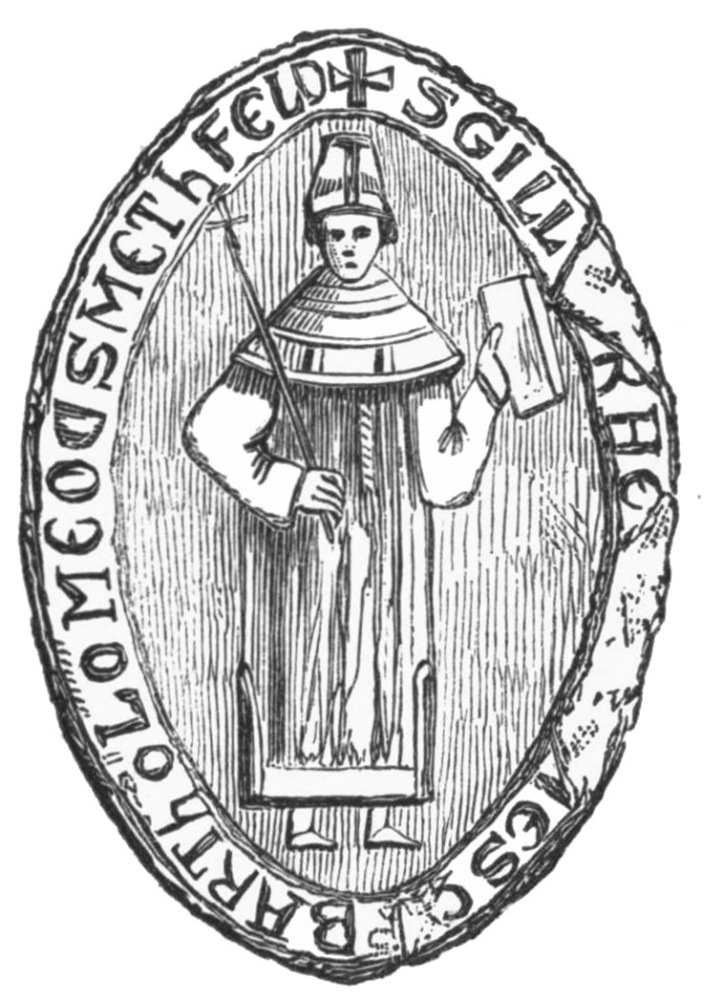
The earliest two seals, attached to a deed of 1137, show:i) (seal, left) Rahere as prior. Rahere is in typical prelate's pose - cross in right hand, Bible in left.  Inscription seems to be: SIGILL' RAE...IES C BARTHOLOMEO SMETHFELD
ii) (counterseal, right) a church with three towers.
Cf churches on the seals of Burscough and Canterbury, shown here. Legend:  [SIGILL]VM CONVENT. ECCLE. DI. ET S. BARTHOLOMEI DE SME[THFELD].  The two legends' lettering is very similar.  The seal and counterseal are depicted in an article from Archaeologia XIX (1817). 

The 12th-century hospital had its own seal (BM 3487), with St Bartholomew nimbed, right hand in benediction, left hand holding a cross crozier, and the inscription HOSPITALIS SANCTI [BART]HOLOME[I]. Normanus notes this seal ad causas (right) on a document from 1164, very similar to the description of the hospital's seal, but with the legend SIGILL' PRIORIS ET CONVENT' S BARTHOLI' LOND' AD CAUSAS.

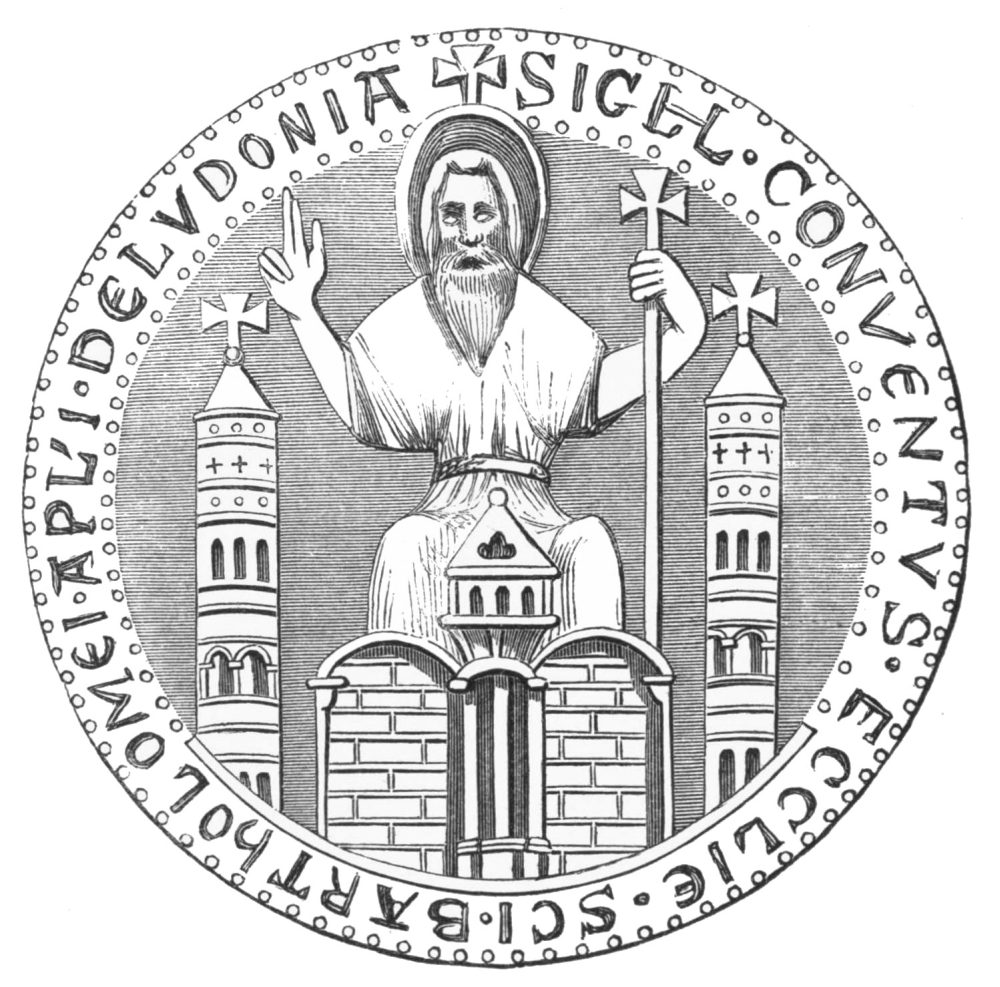
The late 12th/ 13th-century priory had a stonking seal and counterseal.  The seal (below) shows Bartholomew, cross in hand, sitting on or standing behind (I don't quite trust this illustration) a Norman church with two circular side towers.  This seal really reminds me of London's seal from 1219 (below Bart's seal), with St Paul brandishing his sword and pennon.  The Records of St Bart's says that the seal was on documents from 1198 to 1289, and it also notes a similarity between the circular towers here and those in the 12th-century counterseal. The legend is SIGILL · CONVENTVS · ECCLIE · SCI · BARThOLOMEI · APL'I · DE LVDONIA.


The counterseal is also noteworthy (BM 3489).  It's the 'navis ecclesiae', or ship of the church.  The church often appears as a ship  - indeed, the word 'nave' comes from 'navis' - which goes back to that special biblical ship, the ark.  (Here's a nice one at Lincoln.) The influential 12th-century Augustinian Hugh of St Victor wrote De Arca Noe (Of Noah's Ark), which could be found in monastic libraries up and down the land.  Coventry Cathedral Priory also had a ship or ark on its seal.  Here, the ark is a church on a fine hull, with three crosses (west and east end, and central tower), and an estoile and crescent (sun and moon) which is a feature of many seals of the period. A hand extends from the sinister side of the ship; it is clutching - I think - the dove, although that's not quite clear.  The legend: SIGILL': PRIORIS: ECCLESIE: SCI: BARTOLOMEI.


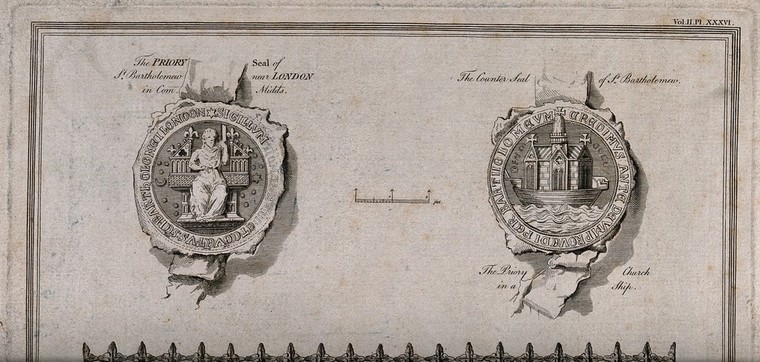
The sigillum commune, or common seal, of the Priory from c.1300 (BM 3492) has Bartholomew seated on a carved throne.  This 18th-century illustration is from the Wellcome Collection, which has it in excellent resolution.  The Records and Birch note a resemblance with the Great Seal of Edward I (illustration below, but there's a better one here).  Bartholomew has his flaying-knife where Edward has his orb, and a book (though not illustrated here) instead of Edward's sceptre.  It even has a beaded border like Edward's.  In addition, there's a moon and sun and two groups of three spots, and the legend reads: SIGILLVM COMMVNE PRIOR' ET CO[N]VE[N]TVS S[AN]C[T]I BARTHOLOMEI LONDON'.

The counterseal is another navis ecclesiae.  The church itself is a lovely bit of Early English, with three lots of two lancets, east and west end surmounted by trefoils, centre by a quatrefoil. It's a nice updating of the previous counterseal. The legend is a couplet such as was all the rage on episcopal counterseals: CREDIMVS: ANTE: DEVM: PROVEHI: PER: BARTHOLOMEVM ('we believe that we are brought before God through St Bartholomew'.)
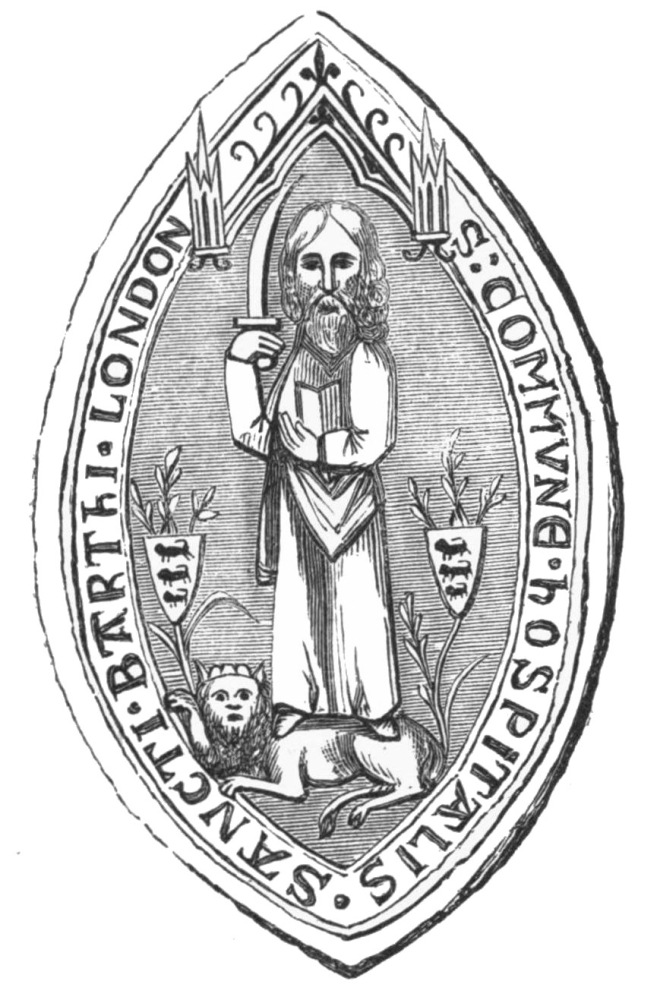
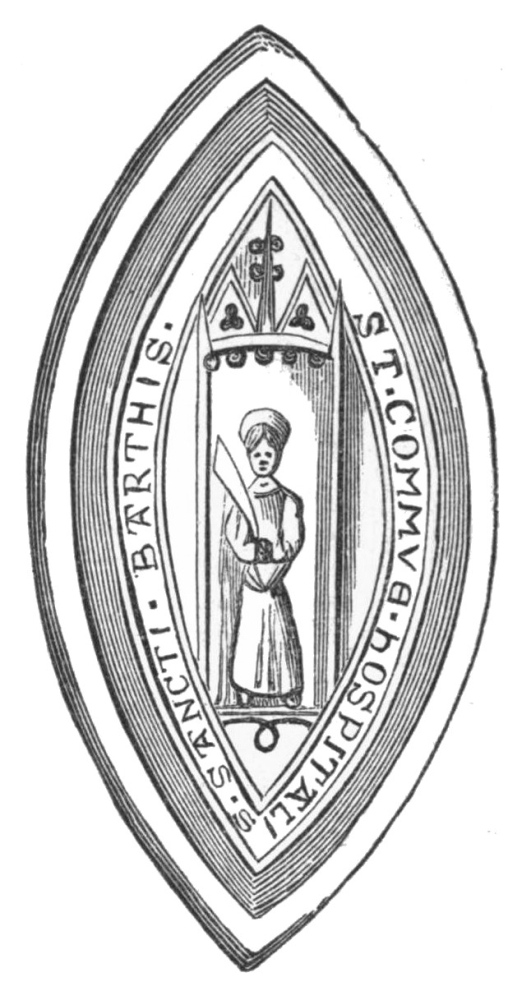
The hospital seal from around the same time is a pointed oval, with Bartholomew holding his knife and book. He has either side of him two saplings with shields hanging on them, with the English leopards on them, and he stands on a lion couchant guardant. Over his head is a trefoiled canopy, pinnacled and crocketed. Legend:  S: COMMUNE · hOSPITALIS · SANCTI · BARThI · LONDON.  A later version of this, on a document of 1529, is pictured right.

A 14th-century seal ad causas (BM 3495) is a pointed oval with Bartholomew standing on a corbel with a flaying knife in his hand and a cross crozier in his left. The legend is: [SIGILLUM PRIORIS] ET CONV[ENTUS SANCTI BAR]THOL'I LOND AD CAVS[AS].

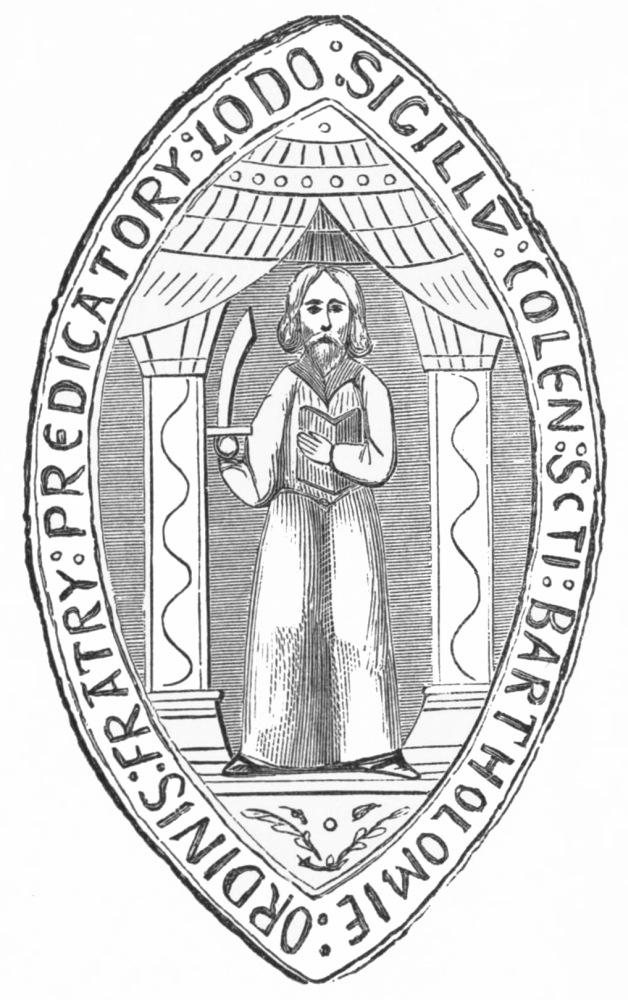
After the Dissolution, Mary I established a Dominican friary here. St Bartholomew holds his flaying-knife in his right hand and a book (the Bible) in his left, and stands under a renaissance canopy, between two columns and on a decorated corbel.  The legend reads SIGILLV: COVET: S'CTI: BARTHOLOMEI: ORDINIS: FRATRV: PREDICATORV: LODO:

Monday, June 22, 2020

SS Mary and Hardulph Breedon

The lovely chap who's spending his retirement blogging about Great English Churches has a good post on this one, so I'm not going to describe it (much), and he's got plenty of nice photographs.  There's another good post on Leicestershire Churches.

Photo: Archaeodeath
Breedon is one of a number of Austin priories with Anglo-Saxon foundations, like Bodmin or Plympton. (There's a whole thesis you can read on this here.)  Breedon was re-founded in the early 12th century with canons from Nostell, and seems to have been a cell of Nostell, with only as many canons as you could count on one hand.  But it kept its Anglo-Saxon minster sculpture, and its dedication to St Hardulph, though now, of course, accompanied by the BVM (although from the looks of this sculpture, she was already there!).

Hardulph was probably Eardwulf of Northumbria.

At some point, one of the priors tried to get independence for Breedon from Nostell.  He resigned.

Now, the seal (no picture, sorry).  An oval at 7/8 x 3/4", this seal is on the small side.  It's from 1377, and shows St Peter standing beside a tree, with a book in his right hand and two keys in his left hand.  I'm not quite convinced by Birch's transcription of the inscription - SAVN…PETR’ - I don't know what he thought 'savn' means, but I've not seen the seal, and he's usually pretty good.

I don't know any other depiction of St Peter standing by a tree.  I am, ahem, intreegued.

Saturday, June 20, 2020

Grace Dieu

While we're on extraordinary women (see last post on the Elas Longspées), let's look at Rohesia de Verdun, founder of Grace Dieu, north-west of Leicester.

Photo: de-verdon.uk
Roesia de Verdun (d.1247) was the heir to a not-insignificant house, and therefore was quite eligible.  Shewas married first (it seems) to Nicholas de Beaulieu (whoever he was) or was it William Perceval de Somery (whoever he was)?  Different sources say different things.  But they agree on her second husband, Theobald Butler of Ormond.  This marriage was Henry III's particular request.  Roesia bore Theobald five children, but the fact that she shelled out 700 marks on his death to remain a femme sole suggests that marriage didn't agree with her - or else that she was determined to hold on to her estates. And here's an interesting thing about her - like Ela II, she kept her family name.  As sole heiress, she also kept the family estates, which she passed on to her son John.

In the 1230s, Roesia built Castle Roche, Co. Louth.  She reportedly defenestrated the master mason towards the end of the project, so that he'd not be able to divulge the secrets of its unique construction, but that no doubt is misogynist hogwash.

In the late 1230s, she established Grace Dieu, and had retired there by 1242, dying only in her mid-forties in 1247.

A couple of years later, Adam Marsh, perhaps at the behest of his friend Mr Thomas de Verdun (relationship to Roesia not clear), wrote to the Bishop of Lincoln and others to make sure that the convent was adequately founded and provided for.  And it seems to have been.  It attracted other benefactions in the 14th century; by the 15th, there were 14 nuns (it's not unlikely that this number was fairly stable throughout), with two dozen male servants and a handful of female ones.  The nuns' clothing allowance was worth 6s. 8d., so a couple of stones of wool per year, or a couple of hundred quid in today's money.

And now, the seals.  Alas, no pictures (yet).  The 13th-century priory seal is a pointed oval: Christ, on a throne, under a trefoiled canopy supported on slender shafts; right hand in benediction; left hand holds a book. In base, under a trefoiled arch, female figure (the founder) kneeling and holding a charter.
SIGILL' CONVENT' . . . . ALVE DE GRATIA . . .

Theobald de Verdun
This charter is a lovely touch. I've not come across other such charter-bearers, although I'm sure that the unique Roesia can't be unique here.
Roesia's own seal:  she stands in a tunic of the Verdun arms (fretty), holding two shields, one being the Verdun arms. The other has, apparently, an indenty fess; possibly Butler. (I’ve not seen this seal). Nigel Tringham describes another seal, in which ‘she holds a burning lamp in her right hand’.

By the way, the second prioress of Grace Dieu was Alice de Gresley.  Her seal, from 1269, has the BVM on a throne, Child on left knee, under a trefoiled canopy supported on slender shafts. At the sides of her head, dexter, a crescent, sinister, an estoile. In base, under an arch, the prioress kneeling in prayer.


Thursday, June 18, 2020

Ela Longspée and Ela Longspée

I belong to a web group that occasionally posts 'silly plurals', and here's one for them, I think.  We have here two outstanding women, mother and daughter, both called Ela.  Are they the Ela Longspées, the Elas Longspée, the Elas Longspées?

The first Ela was Countess of Salisbury, and founder of Lacock Abbey.  The second, her daughter, was Countess of Warwick, a patron of Walter of Merton's college at Oxford, and was buried in Oseney Abbey.  Both women were, therefore, patrons and benefactors of the Augustinians.  (L. L. Gee has written about women as Austin patrons, and Emilie Amt has written about Ela II.)  So they can both quite happily appear here!  Let's look at their seals and counterseals.


 These make for a good spot-the-difference.  They are not dissimilar to that of Joan de Munchensy, Countess of Pembroke, who holds a hawk. Joan's background is plain; Ela is surrounded by .  What, if anything, the hawk signifies is discussed elsewhere, but the figure's dynamic-but-elegant pose is worth noting.  Ela I stands between two lions, not so much rampant as climbing the walls.  (Perhaps they're after the bird.)  She stands on a nice corbel.  Her daughter also has a nice corbel, and instead of rampant lions, she has a couple of rampant ramblers.

The counterseals:  both heraldic, showing that the shield had already gone from primarily military to a proclamation of lineage.  Ela I's has the six lions rampant of Longspée.  Ela II has two lions passant above and below her shield, which is encased in a hexafoil.  It has the six lions rampant, and the inscription shows that although she's Countess of Warwick, she's still a Longspée.  It wasn't common for women to keep their names, but not unknown, especially when the woman was descended from people like Ela's parents...  She was Longspée and proud.

Ela's second seal is more mid-to-late century in style, with a church-style canopy.  She stands on a fleur-de-lys corbel.  The three shields on seal and counterseal are hers and her husbands'.  Thomas Beauchamp, Earl of Warwick is dexter on the seal; she holds, sinister, her Longspée shield; the counterseal is Philip Bassett.  Again, the counterseal arms are encased in a foil, this time a quatrefoil, with dainty trefoils at the corners, and between two lions rampant.


Another image of Ela II's seal is here, from the Merton College archives.


Plympton


Image result for plympton priory seal
From Monasticon Dioesis Exoniensis (1846)
Bishop William Warelwast of Exeter was on a drive to improve the standards of canons in his diocese. In 1121 he disbanded the secular college founded by the Anglo-Saxons and instituted an Augustinian house, the Priory of St Peter and St Paul, using canons from Holy Trinity, Aldgate, and Merton Priory.  It's probable that one of those Merton canons was a chap called Geoffrey, who in 1130 or so became prior.  The history of Plympton is here, and de Gray Birch's description of the seals here.

The priory seal is 13th-century.  Peter and Paul sit on a bench or throne, with beaded nimbus and books, and their symbols.  They sit atop a lovely carved corbel of foliage.  The inscription Birch notes as

SIGILLVM : ECCLESIE : AP'LOR …..RI : ET : PAVLI : DE : PLIMTONA.

But surely that must be A PRIORATU SANCTE PETRI ET PAVLI.

He describes its counterseal - BVM, crowned and throned, the Child on left knee; in right hand an orb topped with a fleur-de-lis on which a bird perches.  + SIGNVM : SANCTE : MARIE : DE : PLIMTONA.  Mary was the most popular saint for Austin houses. 

Continuing the Marian theme, Prior Richard de Tregony's seal (1280) has a half-length BVM, with Child on left arm, under an arch of five cusps; below, two quadrilobes containing on the left, St Paul's bust, with a sword and over the head an estoile; on the right, St Peter's, with keys and over the head a crescent. In base, under a pointed and trefoiled arch, the Prior, kneeling in prayer.  The quadrilobes sound very similar to the windows on Merton's seal. Merton held land in Tregony, and indeed its prior in the 1290s was Nicholas Tregony - perhaps some relation to Richard.  I'll try to get a picture of this seal.

Plympton's seal, I feel, needs the caption 'And it's goodnight from him...'